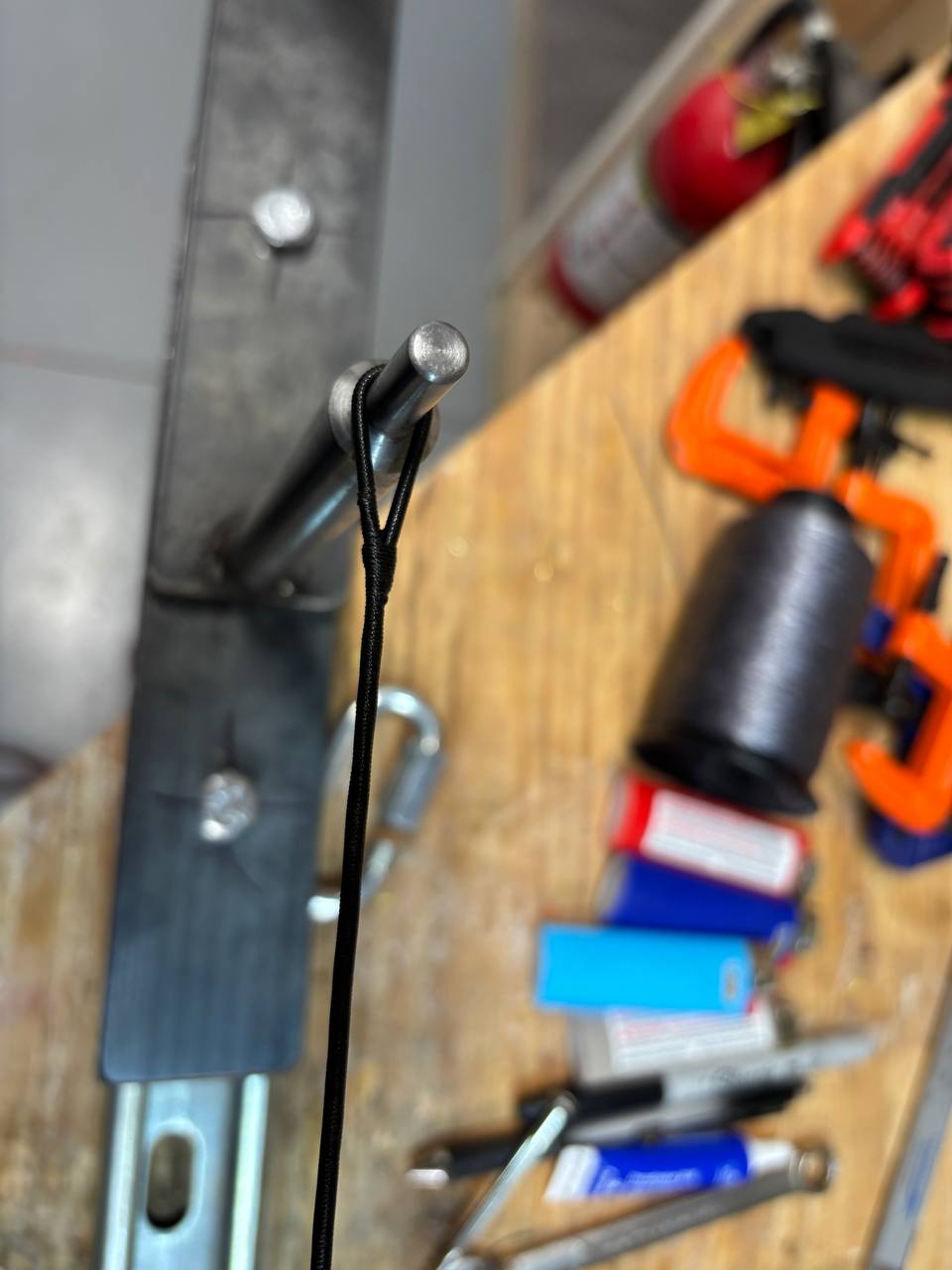
Serving is a mechanical operation that looks harder than it is. Once the tension on the serving jig is set and the material is running cleanly, laying down a section of center serving takes only a few minutes. The technique matters — covered in the sub-article Center serving — how to start, how much tension, how to back-serve — but the technique is not the hard part of this stage.
The hard part is what happens before the first wrap. Two decisions get made here, and both of them decide whether the string is ready to be served or whether serving now will lock in a mistake that shows up on the bow.
The pre-serve length check
The string comes off the tensioning jig and back onto the building jig. Apply 100 lb of load — the same constant measurement load used throughout the build — and measure outside-to-outside of the primary posts.
The target is the pre-serve length calculated in Part 2: final − 1/16" for strings 40" and longer, final − 1/32" for strings under 40", and pull-to-final for yokes under 20". This is the number that leaves exactly enough room for the final 300 lb stretch in Part 7 to bring the string to its finished length without needing any twist correction.
If the string measures within 1/16" of the pre-serve target, it is ready to serve. Proceed.
What to do if the measurement is off
If the pre-serve measurement is off by more than 1/16", the correction path is not "add or remove twists and start serving." It is longer than that.
Add or remove twists to bring the length to target. Then take the string back to the tensioning jig and repeat the entire tensioning and burnishing stage — 200 lb load, burnishing to 110–120°F, hold until the drop rate falls below 1 lb per minute. Then re-check the length at 100 lb on the building jig.
The reason: every twist added or removed after the initial tensioning stage destabilizes the bundle. The wax that flowed and set at 115°F did so around a specific strand geometry. Adding twist changes that geometry. If the string is served in that state, the serving locks in an unstabilized bundle, and the service-life consequences show up as center-serving shift, peep rotation, and timing drift.
A well-planned build lands within 1/16" of the pre-serve target on the first tensioning pass. If a build regularly requires re-tensioning at this stage, the numbers being carried forward from earlier stages need review — most often the post-twist target from Part 4 was hit imprecisely, or the tensioning hold in Part 5 was cut short before the drop rate reached the threshold.
Marking the serving locations
With the pre-serve length verified, the serving locations get marked on the string while it is still under 100 lb of tension on the jig. Serving is done at that same 100 lb load — not at the 200 lb burnish or the 300 lb final stretch. The bundle geometry that was measured at 100 lb is the geometry the serving needs to lock in — and 100 lb is also the expected operational load of the string in service.
Mark the start and end of each serving section with a fine Sharpie, and write those numbers down for future reference builds on the same bow.
Running the center serving
Center serving is done with an adjustable-tension serving jig, running Halo for the durability required at the nocking point. Serving material choice is a separate discussion worth an article of its own; a follow-up piece will cover material selection in depth.
The serving jig applies constant tension to the serving material as it is wrapped around the bundle. That tension determines how tightly the serving grips the string, which in turn determines whether the finished serving stays put in service or whether it shifts under repeated release-load cycles.
Sub-article to follow: a dedicated piece on how to run a clean center-serving section, covering material selection, tension settings, start and finish techniques, and how to tuck the ends invisibly.
End serving
End serving is completed in the same fashion as center serving, but the wrap travels toward the end loop so there is a clean overlap at the junction between end serving and end-loop serving. That overlap is a real indicator of build quality. Please see the dedicated serving articles for the mechanics.
The peep-strand question
Here a decision gets made that most builders make one way and Axial makes the other. It is the decision that most directly connects the string-building process to what the archer experiences on the bow.
The common practice — and the practice most factory-built strings use — is to install a placeholder strand at the peep location during layup. A piece of extra fiber, or an actual peep strand, is included in the bundle at approximately the midpoint of where the peep will eventually sit. When it comes time to install the peep on the bow, the technician finds this placeholder, uses it to separate the strands cleanly, and installs the peep in the gap.
It is a sensible-looking practice. It makes peep installation faster. It ensures the peep sits at a defined location in the bundle. It has one problem, and the problem is fatal to string stability.
The correct procedure for peep installation — the one Axial builds strings to support — is to find the correct rotational position on the bow, mark the string at that point, and then separate the strands cleanly for peep installation without any placeholder committing the location in advance. This is a bow-technician-side procedure, not a string-builder-side procedure, and no forethought at the build stage will do a better job of predicting it than the technician doing it on the bow with the archer's setup in view.
The archery world has come to associate peep rotation with a string problem. It is not, in most cases. It is the downstream consequence of a build practice that pre-committed to a peep location and then required post-installation twist corrections to make that pre-commitment work. Every one of those twist corrections destabilizes the bundle. Every destabilization shows up as more rotation. It is a self-inflicted loop.
Cross-reference: Peep rotation — what it actually means and how to fix it covers the diagnostic and correction procedures in depth. The short version: a rotating peep is a signal of an unstabilized bundle, and the correction is a fresh 300 lb hold — not more twist adjustments.
Handoff to the final stretch
Once the center serving is complete and any other serving sections (cable-stop serving, cam-groove servings, additional wear-point servings depending on the bow) have been applied, the string returns to the tensioning jig one last time.
The final stretch — 300 lb, slow ramp, minimum 30-minute hold — is what turns a served string into a finished string. Part 7 covers that stage in detail.
Published 2026-07-04 · Axial Bowstrings