The string is served. Center serving, end serving, cable-stop serving — every section that will exist on the finished string is now in place. The bundle has been through tensioning and burnishing. The strands are seated. The wax has flowed and set.
The final stretch does not create stability. It verifies it.
A stable string, taken to 300 lb and held, will move a small predictable amount, stop moving, and stay stopped. An unstable string will move, and keep moving, and never quite settle. The final stretch is where the difference becomes visible — and where a build either passes or fails.
The move back to the tensioning jig
The served string comes off the building jig and returns to the tensioning jig — the same simpler two-hook fixture used for the 200 lb hold in Part 5.
The string that goes onto the tensioning jig for the final stretch is the string that will come off it finished. Nothing else will be done to the bundle after this stage — no more twists, no more tension corrections, no more serving. Whatever the string is at the end of the 300 lb hold is what the customer will receive.
The slow ramp — 200, 250, 300
The load does not go directly to 300 lb. It ramps.
The reason for the ramp is the same reason 200 lb was the ceiling in Part 5. BCY material has a specific tolerance for rapid load changes. A cold pull from zero to 300 lb concentrates all the load onto whichever filaments happen to be shortest in each strand at that moment. The ramp allows the load to distribute across the full filament population inside each strand before the peak is reached.
At 200 lb, the string will settle briefly — just as it did in the earlier tensioning stage, though less dramatically because the strands are already largely seated. Watch the scale. Once it holds within a few pounds of 200 over 30 seconds, move to 250. Repeat the check. Move to 300.
The whole ramp typically takes two to three minutes. It is not a long process. It is not optional.
Why 300 pounds, and not more
The final stretch load is 300 lb for a traditional full-size adult compound string. That number is a ceiling as much as it is a target.
Above 300 lb, the same failure mode discussed in Part 5 applies — filament damage — with one added factor: the string is now served, and the served sections concentrate load differently from the unserved bundle. Loads above 300 lb applied to a finished string transfer disproportionately through the served sections, creating stress at the transition points that can compromise the serving-to-bundle interface without visibly damaging either.
Some builders run this final stretch at 400 lb or higher, on the reasoning that a heavier stretch produces a "pre-broken-in" string. The reasoning has the same flaw discussed in Part 5. What appears to be a broken-in string is a string with reduced filament count. That reduction is invisible until the load environment on the bow finds it — and by then, the string has already been sold.
Youth strings, short-draw setups, and specialty builds may use lower final-stretch loads scaled to their normal service tension. The principle holds regardless of the number: the final-stretch load should exceed the highest load the string will see on the bow, by enough to guarantee stability, but not by enough to cause damage. For a typical adult compound at 60–70 lb draw weight producing peak loads of 200–250 lb at the cable/string interface, 300 lb is the number that satisfies both requirements.
The hold — minimum 30 minutes
Once the load reaches 300 lb, the hold begins. The clock starts. Watch the scale.
In the first minute, the scale will drop. This is not the string failing — it is the same settling motion seen at 200 lb during tensioning, now happening at a higher load and with a smaller amount of movement available. Chase the load back to 300. The scale will drop again, slower. Chase it back.
By 10 to 15 minutes into the hold, the drop rate should be under 1 lb per minute — the same threshold used at the 200 lb stage. If the drop rate is above that after 15 minutes, one of the earlier stages was done wrong, and the string is either not yet stabilized or has strand-count or geometry problems that no further hold time will resolve.
Extended holds beyond the point where the scale has stopped are not doing further stabilization work. The wax has already flowed and set at 115°F back in the tensioning stage. The strands have already seated at 200 lb. The bundle has already committed to its final geometry. A 300 lb hold that has stopped moving is a string that is finished.
Verifying the final length
After the 300 lb hold completes, the string returns to the building jig one last time for the final length verification.
Apply 100 lb — the same measurement load used at every previous check. Measure outside-to-outside of the primary posts. The measurement should be dead-on the target final length, or within one-half twist of it.
| Result at final check | What it means |
|---|---|
| Exactly on target | Every earlier stage was done correctly. |
| Within 1/32" or one-half twist of target | Acceptable. No corrections. |
| Off by more than one twist | An earlier-stage number was hit imprecisely. Do NOT correct with twist changes now — the correction will destabilize the bundle. Note the deviation and use it to calibrate the next build. |
The third row is the hard one. A finished string that came off the jig 3/32" long looks fixable — just remove a twist. The rule that runs through every stage of this build says otherwise. A twist added or removed at this point undoes the stabilization that took the previous six stages to earn. The string may be 3/32" long, but it is stable. A string that is dead-on target but has been twist-corrected after the final stretch is not.
Why this matters — the connection to service life
Every principle in this seven-part series comes back to one measurement: how much the string moves after it has been installed on the bow. That movement — center-serving shift, peep rotation, timing drift, cam sync change — is the visible symptom of an unstabilized bundle continuing to settle in service instead of on the jig.
A string built to the process described here will settle on the jig. All the settling that will ever happen to that bundle happens during the tensioning stage at 200 lb, the burnishing at 115°F, and the final stretch at 300 lb. By the time the string reaches the customer, every fiber has already made every move it is going to make. On the bow, the string does not drift because it has nowhere left to drift to.
A string built with any earlier-stage shortcut — a hard pull during equalization, an under-tension burnishing, a skipped hold, a post-stretch twist correction — has drift left in it. That drift will happen on the bow because it did not happen on the jig. Every source of on-bow instability points back to a specific stage in the build where the required work was not done.
Storage after the final stretch
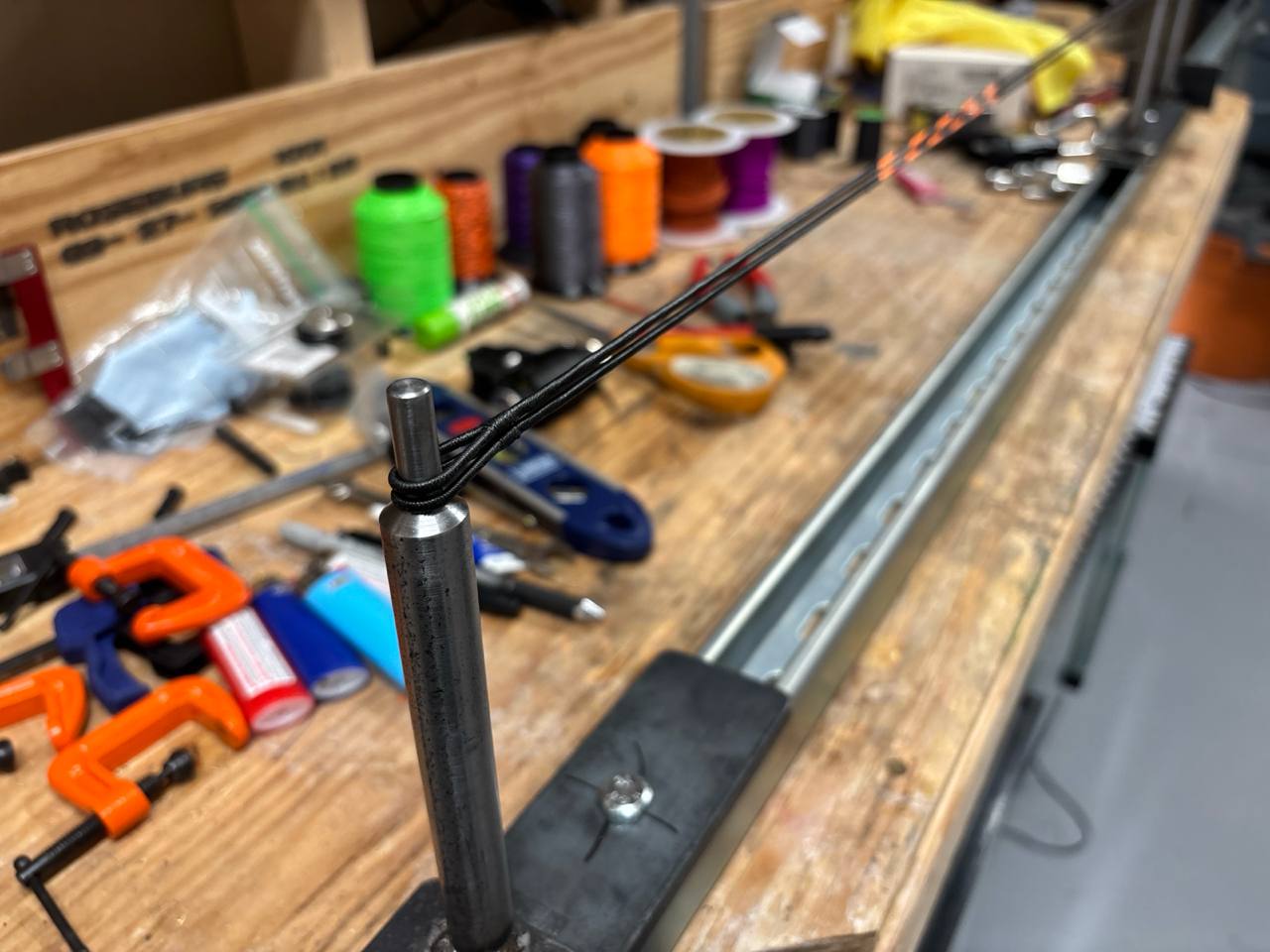
Once the length has been verified, the string comes off the tensioning jig for the last time. From this point forward, the string should not lose or gain twists in storage — the finished geometry has to survive from the shop to the bow untouched.
For target-grade strings, linear storage is the safer choice. The string is hung by both end loops on a hook, straight, and stays that way until installation. Coiled storage in a Ziploc bag is workable for lower-tier strings and for shipping constraints where linear storage is not possible, but the trade-off is real: strands open up along the coil radius, and whether they reseat to their original geometry on install is not guaranteed. Usually they do. Not always.
The safest handoff from the shop to the archer keeps the string in the same geometric state it was in when it came off the jig. Every deviation from that — coiled storage, folded storage, prolonged storage in warm environments — is a chance for something to shift. A well-built string will forgive most of that. A well-built string that has been asked to forgive nothing is the better product.
The end of the sequence
The finished string comes off the jig, gets its length verified, and gets hung for storage. That is the whole process.
Every stage has been about the same thing: setting up the bundle so that its finished geometry is a state it wants to be in, rather than a state it is being held in. A string built this way does not fight the archer. It does not drift. It does not require re-tuning at three months and again at six months. It reaches the bow already finished, and it stays that way.
That is what the Axial process is. It is not shorter than other processes. It is not cheaper. What it produces is a string that behaves the way the physics says it should, because every stage in its construction respected the physics of what was being built.
← Part 6 · Back to String Building
Published 2026-07-04 · Axial Bowstrings