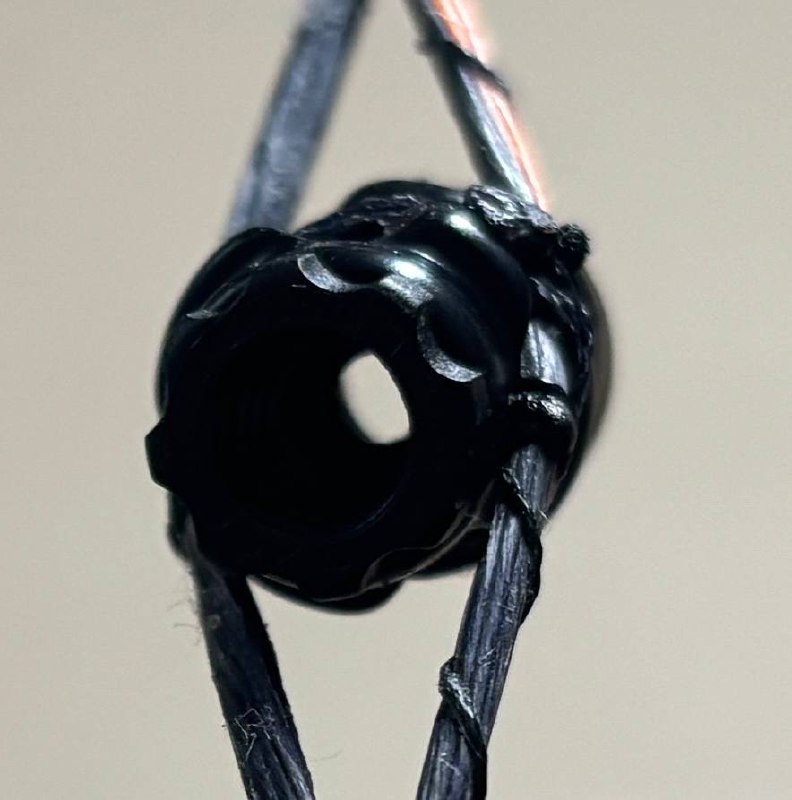
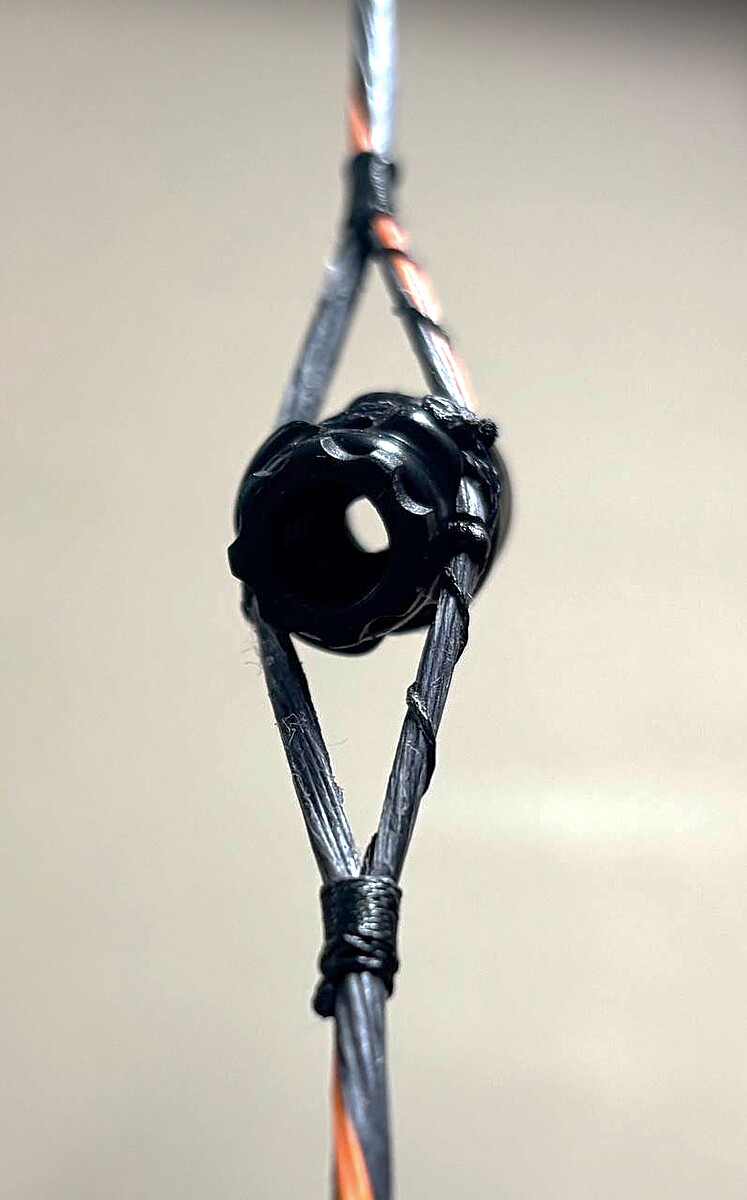
The problem shows up in two ways. Either the peep sits off-axis to the sight and the target, giving the archer a non-circular sight window with all the visual errors that follow, or the peep rotates during the draw cycle and lands in a slightly different orientation on every shot. As you would expect, both produce measurable errors downrange.
Cause
The peep is a small circular object inserted into a helical structure. Its job is to give the archer a fixed reference between the eye and the bow-mounted sight. The helical structure is the real source of the frustration.
A bowstring is nothing more than roughly two dozen strands of fiber twisted into a helical form. That helix is what creates the strength and stability of the string — without it the string could not function. But it also means the peep is embedded in something that has a natural rotational geometry. When that geometry changes, the peep rotates with it.

That is why a peep will rarely stay perfectly still on a string that has not fully settled. The bundle wants to keep working out its twist, and the peep is riding along with it.
The four fixes
A local bow shop will typically offer three fixes for peep rotation. None of them are true permanent fixes in most cases. There is a fourth option Axial prefers, and it is rarely mentioned.
Fix 1. Adjust the D-loop so it twists the string at full draw.
Logical, and it works for a short time. The D-loop is under tremendous strain during the draw and tremendous vibration during the shot. Both of those actions pull the D-loop back toward a rotational rest position, and once it settles there it no longer functions as a directional corrector.
The bigger question is whether you want anything in the system actively forcing a rotation that may not be consistent from shot to shot.
Fix 2. Twist the peep against the error before you draw.
A compound bow is a very consistent machine, and peep rotation at full draw tends to be repeatable from shot to shot. So you learn which direction the peep goes off, and give it a small flick or nudge before drawing back — often pivoting it just enough to sit straight at anchor.
The problem is that you know there is a mechanical issue with the bow, and a flick is not a consistent input. This is usually the only option for an archer who is not willing to do real surgery on the string. It is not uncommon — even at a tournament — to catch yourself using this tactic right up to the moment you draw.
Fix 3. Press the bow and add or remove a twist from the main string.
This is the tried-and-true path. It also often leads to further peep rotation in the near future, and to a long battle with the string.
To understand why, you have to look at the geometry of the strand bundle — and this is where it helps to have read the string-building article, and to understand why a good string builder works so hard to avoid adding or removing twists after the string has settled.
A modern main string is often more than 60% served, which means most of the helical geometry is fully locked in and cannot move. A typical adult bow runs about one twist per inch, and typically only around 16 inches of unserved string material. That means adding or removing a single twist is a 6.25% change to the helical nature of the exposed strands. That is a significant destabilization, and while the string is on the bow the bundle will not fully re-stabilize. It keeps moving for a long time.
If this is the path you are going to take, the best way to finish the process is to remove the string from the bow, put the main string in a stretcher, and pull to 300 lbs for 10 minutes. Under tension you will see the peep spin around and then settle into its true position. Burnishing at this stage helps the string re-stabilize.
When you reinstall the string on the bow, keep the peep in the correct orientation as you hook the ends. It usually works, but it can be a fight. The D-loop is almost never in the right place after this process and typically needs to be reinstalled.
Fix 4. Remove the peep, let the string settle, and reinstall by splitting the strands in the correct position.
This is the option Axial prefers, and it is the one you will rarely hear from a shop. Remove the peep. Let the bow expand back onto the string. Shoot a few shots and let the string settle into its natural rest state. Then reinstall the peep by splitting the strands at the correct orientation for the height where the peep needs to sit.
This is also why Axial does not always supply a pre-made peep split with a string set. Installing a peep correctly requires finding the correct helical orientation at the exact height the peep will sit. If a peep split is provided, it forces the installer to install the peep at whatever orientation the split was made for, and then twist the string to make the peep face the right way. That immediately starts the whole process with an unsettled main string.
The other symptom: peep rotating during the draw
Have you ever looked at your peep — or someone else's — with the bow at rest and thought, that peep is almost 90 degrees off? It happens a lot, and it is a real source of accuracy error.
When the peep rotates as the bow is drawn, it means the strands are not settled. The change in length of the string between the cams during the draw is allowing the helical form to shift. That is an accuracy killer, because the peep will rarely rotate back to the exact same position twice in a row. The more degrees the peep rotates, the more degrees of error you get on every shot.
The fix is the same underlying process. Take the main string off the bow and put it in a string stretcher at 300 lbs for 10 minutes. You will see the peep rotate as tension is applied — that motion is the evidence there was an issue. While the string is under tension, burnishing helps it settle. Then reinstall the string with the peep in the correct orientation. The D-loop will usually need to be reinstalled.
If a string stretcher is too much to ask, an on-the-bow version can help. Run the tiller bolts all the way in to load the limbs as much as you safely can, then burnish the exposed string. It is not as effective as a proper stretcher session at 300 lbs, but it does help the string settle. Worth noting that changing tiller tension changes the forces acting on the string, and that alone can shift the peep's rest orientation — so expect to re-check the peep after any tiller adjustment.
Axial generally recommends a full peep reinstallation to fix rotation, but some archers prefer to raise or lower the peep to find a position where it happens to sit straight — and on a compound bow the peep is your anchor, so a small height adjustment is not a trivial change.
Some companies also make peep tuners, small objects placed between the strands that alter the helical form near the peep and rotate it into line. They work. Axial prefers a true settled form over an altered one.
Published 2026-07-04 · Axial Bowstrings