By the time a string reaches the tensioning stage, it has already been asked to become a bundle. The twisting stage did most of that work — the individual strands are now wrapped into a helical structure, held together by the twist and by the tension against the end-loop serving at each end.
What the string is not yet is stable. The strands are consolidated but not seated. The wax on the material has not yet migrated into the interstices between fibers. The bundle looks like a bowstring but feels like a rope — you can see the individual strands, and if you compress the bundle between your fingers you can feel it flex more than a finished string should.
Tensioning and burnishing is the stage that resolves both of those. It is short. It is hot. It is the most important stage in the entire build for the long-term stability of the finished string.
The move from building jig to tensioning jig
The freshly-twisted bundle comes off the building jig and onto the pre-tension jig — the simpler two-hook fixture described in Part 1. This is a physical transfer: unhook the end loops from the building posts, carry the string linearly to the tensioning jig, engage both end loops on the tensioning hooks.
Keep the string straight through the transfer. Do not let it coil, do not let one end unwind against the other. The twist that was measured at 50 lb on the building jig is the twist the string carries into tensioning. Anything that changes it — the string being dropped, the S-hook flipping, a loop rolling — has to be undone before tensioning proceeds.
200 pounds. Not more.
The target load for this stage is 200 lb. That is not an approximation.
The temptation to pull harder is real and pervasive. Some builders run this stage at 300 or even 400 lb, on the reasoning that a heavier pre-stretch produces a "deader" string with less remaining ability to elongate. That reasoning ignores what is actually happening at the fiber level.
BCY strand material — 452X, X99, and their relatives — is a bundle of individual filaments. Those filaments have a working tension range in which the material behaves elastically: it stretches under load, returns to its unstretched length when the load is removed. Above that range, individual filaments begin to fail. Not the whole strand at once — one filament, then another, then another. Each failure is invisible from the outside. What is visible, months later, is a string that has weakened without any obvious cause.
At the tensioning stage, the bundle is not yet supported by serving. It is a set of strands held together by twist and by 2 1/4" of end-loop serving. In that state, 200 lb is the load window in which every filament in every strand is being asked to work at a load below its individual failure threshold.
Reading the scale — watching the settle
Apply 200 lb to the bundle. Then watch the scale.
In the first 20 to 30 seconds, the reading will drop. On a 65" main string, it is common to see the scale go from 200 down to 190, and then continue drifting toward 180, 170, 160 as the strands begin to seat against one another. This is not a leak in the jig. It is the bundle settling.
Chase the load back to 200. The scale will drop again — this time slower. Chase it back again. After a minute or two, the settling rate will slow enough that the scale holds close to 200 with only occasional adjustment. That is the moment burnishing begins.
The scale drop during this first minute is the string doing exactly what it is supposed to do. Strands that were sitting proud of their neighbors seat down against them. Filaments inside each strand shift into a more compact packing. Wax that was locked in place by the initial layup begins to move. Every unit of load that the scale gives up is a unit of load being converted into strand consolidation.
Burnishing — the mechanical half

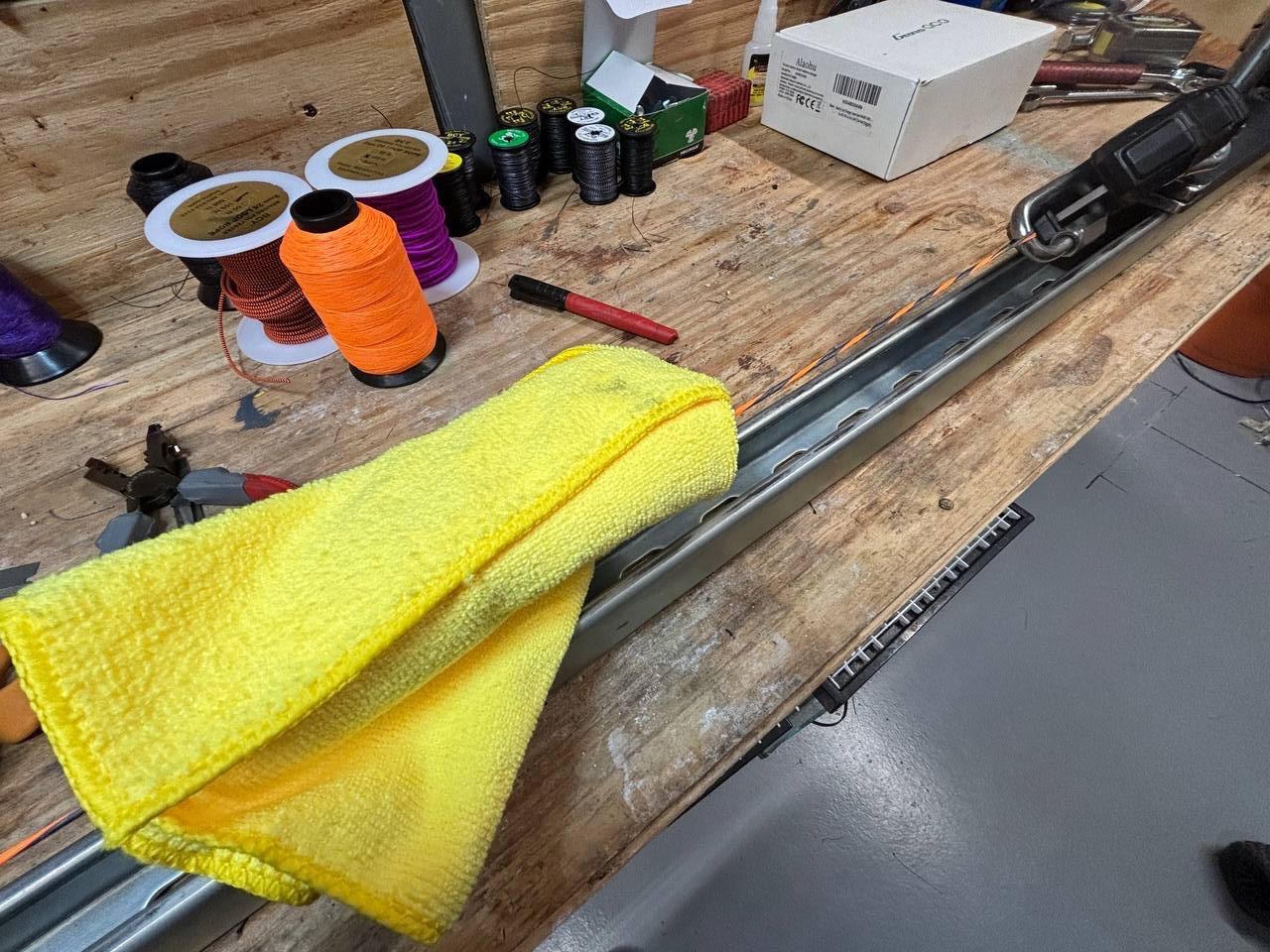
Burnishing is done with a clean microfiber cloth. Not paper towel. Not shop rag. Microfiber — because the fiber structure grabs and holds wax without leaving lint behind on the string.
Fold the cloth so there is enough material to wrap around the string with two or three layers between your hand and the bundle. Grip the string firmly. Move your hand along the length of the string with steady pressure — the same motion you would use to wipe wax off a car after it has set. Not scrubbing, not gentle, somewhere in between. Enough pressure that you can feel the string through the cloth.
Work the entire length of the string in roughly 10-inch sections at a time. Six to seven minutes of steady motion total.
What is happening mechanically: the microfiber is pressing individual strands into their neighbors, closing the small gaps between them. It is smoothing surface irregularities where filaments had been sitting slightly proud. And critically, the friction is generating heat.
Burnishing — the thermal half
The heat is not a side effect. The heat is why burnishing works.
Wax in bowstring material behaves like most waxes: below a certain temperature it is a solid at fiber-scale, and it stays wherever it was manufactured. Above that temperature it softens, flows, and migrates into gaps in the fiber structure that it could not reach when cold.
A properly burnished string reaches 110 to 120°F at the surface. That is a hot number. If you touch a correctly burnished string with a bare finger, it should feel hot enough that you would not want to hold it — right at the threshold of uncomfortable, not past it.
At that temperature, the wax migrates. It flows out of the surface pockets where it was concentrated after twisting, and into the interior of the bundle where the strands are locking against one another. Once it cools — which it does in seconds after burnishing stops — it re-solidifies in its new location. That relocated wax is the difference between a bundle held together by twist alone and a bundle held together by twist plus the mechanical grip of set wax between every strand contact point.
This is what stability actually is. Not "more twist." Not "harder pre-stretch." A bundle whose strands are physically locked to one another by wax that has flowed into every contact point at temperature and set there.
Chasing the load back to 200
Halfway through the burnishing motion, glance at the scale. It will be low. On a 65" main string, it is common to see it read 100 or 120 lb by the time you have been burnishing for two or three minutes.
That is the string relaxing further under the combined effect of tension, motion, and heat. Bring the load back up to 200. Continue burnishing. The scale will drop again, slower this time, and by the end of the six-to-seven-minute burnishing window it will hold close to 200 with only small adjustments.
Throughout this, the visible length of the string is also changing. On a 65" main string, expect roughly half an inch of length change across the tensioning stage. That is not the string being stretched. That is the strands finding their seated positions inside the bundle. The final length of the finished string was planned for exactly this movement — the 0.993 target from Part 4 accounts for it.
What the tensioning stage actually looks like


The hold
After burnishing, bring the load back to 200 lb one last time. Then leave it alone.
The hold serves one purpose: to let the bundle prove that it has stabilized. A stable bundle at 200 lb will lose load slowly and predictably. In the first few minutes it will drop by a few pounds. Chase it back. In the next few minutes it will drop by less. Chase it back. By 10 to 15 minutes in, the scale should be dropping at less than 1 lb per minute.
Some builders run this hold for hours. We are not aware of any measurable benefit past that point. Once the drop rate is below 1 lb per minute, the strands have found their seated positions and additional time under 200 lb load is not doing further work.
What comes out of this stage
At the end of tensioning and burnishing, the string on the jig should:
- Feel uniform along its length under a hand run — no rough patches, no strands riding proud
- Show a visibly smoother surface than it did before burnishing — individual strands less distinct, the bundle reading as a single object
- Hold 200 lb of applied load with a drop rate under 1 lb per minute
- Have reached and cooled from 110–120°F at the surface during burnishing
- Measure approximately half an inch longer than its post-twist length (on a full-size main string; scale to length)
None of those checks are optional. A string that skips any of them will drift in service — either as center-serving movement, as timing changes over the first hundred shots, or as peep rotation. All three are the same underlying failure: a bundle that was not fully stabilized before it was served.
The transition to serving
Once the hold is complete, the string moves back to the building jig for one more measurement. At 100 lb of tension — the constant measurement load used throughout the build — the string should now measure at its pre-serve length, which was calculated in Part 2 as final − 1/16" for strings 40" and longer, or final − 1/32" for strings under 40".
If the measurement is within a sixteenth of that target, the string is ready to serve. If it is off, the correction happens now — before the serving stage begins — because after the center serving is applied, the correction options narrow considerably. Part 6 covers what to do at that decision point.
Published 2026-07-04 · Axial Bowstrings