Twisting does two things at once. It shortens the bundle to a specific length, and it consolidates the individual strands into a helical structure that carries load as a single object. Getting the length right is the more visible job. Getting the consolidation right is the more consequential one.
The Axial approach is not to count twists. Counting works fine as a rough guide, but the string does not care how many revolutions the S-hook made. It cares about its length under the correct measurement load. That is the number we build to.
Rough twist density — 0.5 to 0.75 per inch
The working rule for an adult full-size string is approximately 0.5 to 0.75 twists per inch of finished length. A 65" main string finishes at somewhere around 30 to 50 twists. A 40" control cable finishes at somewhere around 20 to 30. These are starting points, not targets.
The reason to know the rough count is that it tells you when to start measuring. Twisting to a target length by feel, without any sense of how many turns should have gone in, is how a builder ends up over- or under-twisted and blaming the material. 0.5 to 0.75 per inch is the ballpark. The measurement is what closes the gap.
Different string materials shorten by slightly different amounts per twist, and different bundle sizes (strand counts) shorten differently. On BCY 452X in typical bundle counts for a compound bow, this range produces a bundle length within a small fraction of the target. Other materials will land close to that but not identical. In every case, the measurement — not the count — is the final authority.
Setting up for twisting

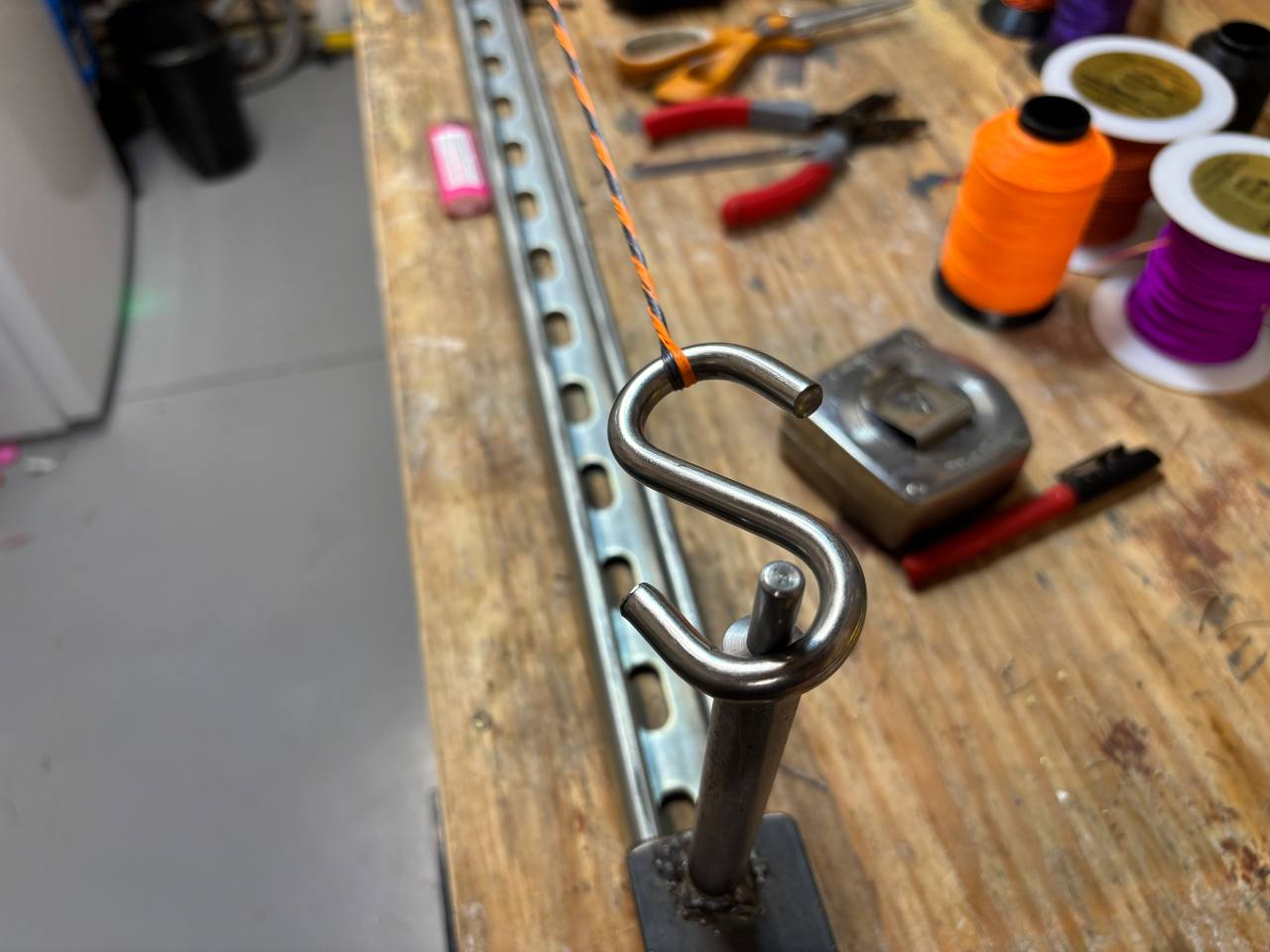
The end-loop serving should sit centered on the S-hook — not offset to one side. An offset here creates uneven twist distribution along the length of the finished string.
Rotate the near end at a steady rate, adding twist to the bundle, while the far end holds against the scale (or against your grip, if the S-hook is in-hand).
Why 40–50 lb: this is the load window in which the strands consolidate cleanly. Below 40 lb, the strands do not consolidate — they twist as a loose bundle, and each strand traces its own helical path independent of its neighbors instead of the whole bundle winding as one.
If a peep split or peep strand is going to be installed, this is the point where it goes in.
Pinstripes, colors, and letting the bundle find itself
On a single-color build, the bundle finds its own helical geometry with no intervention. Every strand seats where the twist and the tension put it. The result is a mechanically clean bundle with no forced positions.
On a multi-color build with a pinstripe, the pinstripe wants to sit somewhere the bundle would not put it on its own. The usual approach is to use strand separators — puck-style or stick-style — to force specific strands into specific positions during twisting.
Separators work. They also compromise the bundle. Puck-style separators concentrate the twist at the ends of the string — the twist has to fight through the geometry the puck imposes before it can propagate down the string, and it never propagates evenly. Stick separators are gentler because they are smaller and impose less geometric constraint, but they still bias the bundle.
For a tournament build where stability is the point, the Axial path is one color, no separators, and letting the strands find their own helical form under the constant 40–50 lb tension.
The measurement that matters
Twist until the bundle is close to the one-per-inch ballpark, then stop and measure.
Take the string back to the building jig. Set it on the primary posts. Apply 50 lb of tension — not more, not less, not "about 50." Measure the length outside-to-outside of the posts. Compare against the post-twist target calculated in Part 2 — final × 0.993.
For a 65 1/4" main string, that post-twist target works out to:
If the measurement is long, add twist and re-measure. If it is short, remove twist and re-measure. Do not eyeball this — the difference between hitting the number and being 1/16" long can be the difference between a finished string that lands on target and a finished string that needs a twist correction after the final stretch. That correction is what destroys bundle stability. This measurement, done carefully, is what prevents it.

Why this measurement is the most important in the build
Every earlier stage has been about preparation. Every later stage is about locking in what the string has already become. Twisting is the last stage in which the length of the finished string is genuinely a decision the builder gets to make. From the tensioning stage onward, the string is settling into a shape it has already committed to.
Which means: if the post-twist length is wrong, the finished length will be wrong. The final stretch will move the string by roughly 0.7% — the same amount that was subtracted at this stage. If the string is longer than target here, it will be longer than target when it comes off the final stretch. The only way to fix that is to add twists back into an already-stretched, already-consolidated bundle, and the moment those twists go in, the bundle is no longer the stable object it was.
The rule that governs everything downstream.
No twist adjustments after the final 300 lb stretch. Not one. Every twist added or removed after that point destabilizes the bundle and causes creep in service. If the post-twist length is right, no adjustments are needed. If it is wrong, no amount of downstream work will make the finished string stable.
Verifying the twist is consistent
Visual check: the twist pattern should look uniform along the entire length of the string. Count the number of complete twists in a six-inch section near one end, then count the same section near the other. If those counts differ by more than one or two twists, the bundle has been twisted unevenly — usually because the tension dropped during rotation, or because separators biased the geometry. A minor difference is normal on a hand-twisted string. A large one is a rebuild indicator.
Handoff to tensioning
Once the post-twist length has been verified at 50 lb, the bundle is considered twisted. The next stage — tensioning and burnishing — is where the strands actually seat into their final positions and the bundle stops being a collection of strands under twist and starts being a string.
The transition matters. Move the string from the building jig to the tensioning jig carefully, keeping the bundle straight, without letting either end loop unhook or the bundle unwind. The twist that just went in is the twist the string will keep. Anything that changes it between here and the tensioning stage undoes work that took real precision to do right.
Published 2026-07-04 · Axial Bowstrings