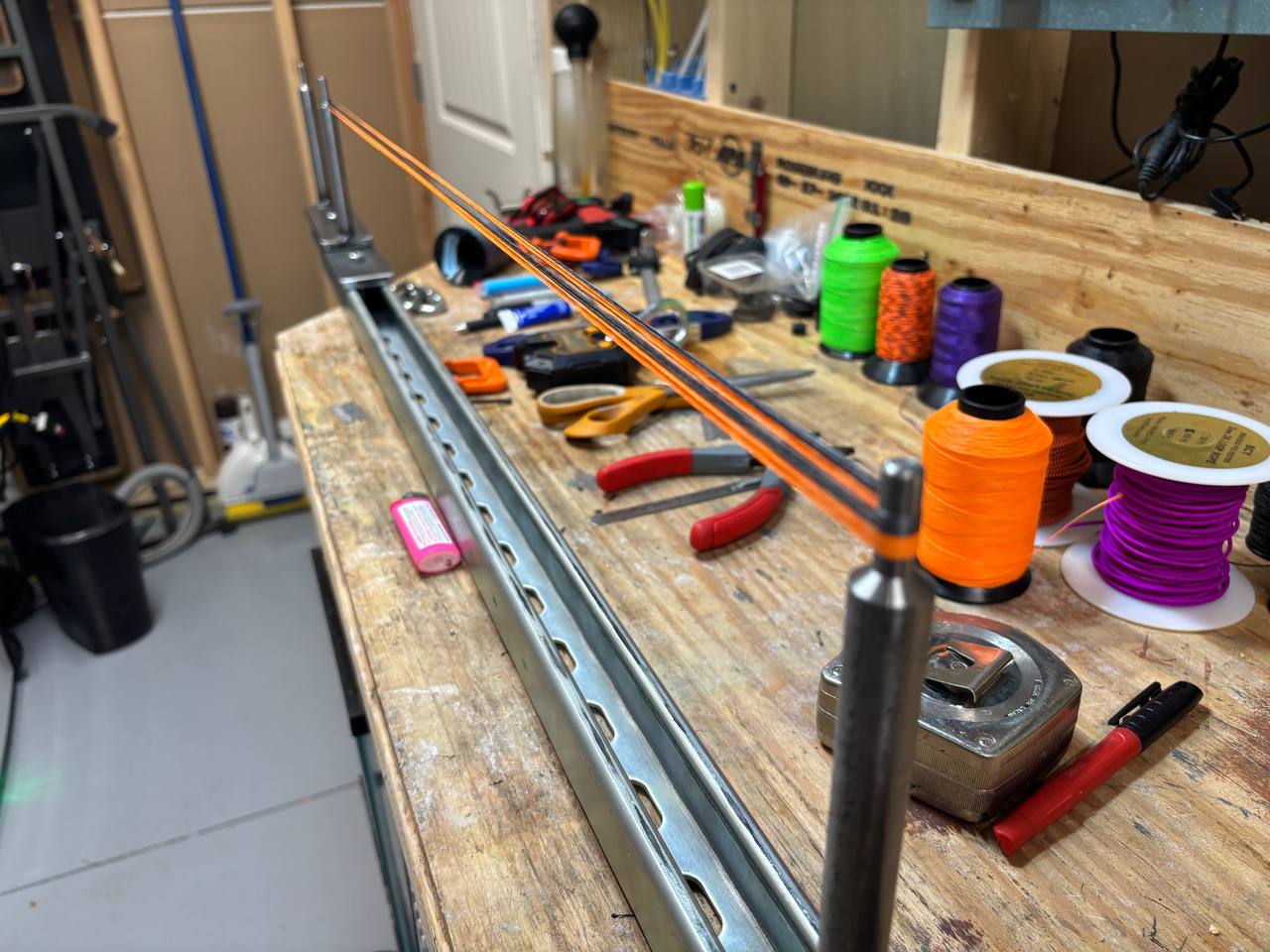
The layup is finished. Both tag ends are anchored. The end-loop serving has been applied. Both ends of the jig have been rotated 90° back so the end-loop serving sits against the primary posts, and the string is ready for the next stage before twisting begins.
A bundle is a collection of strands sharing load equally. What sits on the jig right now is a collection of strands that have been laid up carefully but that have not been under any meaningful load together. Some are slightly tighter than others. Some are slightly looser. The layup was done at 2–3 lb per strand precisely to keep those differences small, but small is not zero.
Strand equalization is the process of closing what remains of that gap. It is one of the shortest stages in the build and one of the most misunderstood.

What "equalized" actually means
An equalized bundle is one in which every strand carries the same tension when the string is pulled. If one strand is 2% looser than the others, the tighter strands carry that strand's share of the load in addition to their own. Under the loads a string sees on a compound bow — routinely 100+ lb, over 200 lb on control cables — that small difference translates into measurable stretch on the loaded strands, gradual accommodation of the loose strand back into the bundle, and creep that shows up as peep rotation and timing drift months later.
Equalization is not something that can be added to a bundle by pulling on it hard. It is a state the strands find, briefly, at the right load — a load high enough for the loose strands to seat against the geometry, and low enough that no strand is being stretched.
Why the tag ends set the ceiling
The temptation, seeing an un-equalized bundle, is to pull it hard. Common sense says the tightest strands will hold, the looser ones will come up, and the differences will disappear.
That is not what happens. The reason is the tag ends.
At this stage of the build, the only thing holding each tag in place is 2 1/4" of end-loop serving. That serving is strong, but it is not infinite. It relies on friction between the serving material and the strand it is wrapped around, and that friction has a working limit. Pull the bundle to 80 or 100 lb before the strands have been consolidated by twisting, and the loosest strand will begin to give — because that is the strand with the least accumulated tension against the serving friction that holds it. It will slide. When it slides, its tag pulls out from under the end-loop serving.
The moment a tag pulls, the equalization opportunity is gone. That strand is now the longest strand in the bundle by exactly the amount it slipped. It cannot be un-slipped without unbuilding the end-loop serving. The bundle has been made less equal by the pull that was supposed to equalize it.
Why 30–40 lb is the right window
Below 30 lb, the applied load is not high enough to redistribute the small differences in strand tension from layup. The strands sit where they landed. The equalization step accomplishes nothing.
Above 40 lb, the load begins to approach the friction limit of a 2 1/4" end serving with no bundle consolidation behind it. Some builds tolerate more; some tolerate less. The 40 lb ceiling exists because it holds for essentially every clean layup, and there is no benefit to running closer to the failure point of the tag anchor.
Between 30 and 40 lb, the geometry has room to move without the tags being asked to hold more than they were designed to hold. Loose strands come up. Tight strands relax a fraction. The bundle finds its equilibrium at low load — which is the equilibrium it will keep once the twists lock it in.
The alternative — twist first, then pull
There is a second school of thought worth naming honestly. Add 8 to 10 twists to the un-equalized bundle first, then pull it to a higher load. The twisting consolidates the strands enough to protect the tag ends from a heavier pull.
This works. It is also self-defeating. Adding twists before equalization means the equalization is happening inside a bundle that has already begun to lock in its geometry. Whatever strand-position asymmetry existed at layup is now baked into the beginning of the twist pattern. The pull afterward can move things, but it is moving them against the resistance of a partially-committed bundle rather than allowing them to find equilibrium freely.
For a builder targeting a stable, low-creep tournament string, the twist-first path leaves detectable asymmetry on the finished product. It is not wrong — it is simply a different set of trade-offs, and it is not the path Axial uses.
What the bundle should look like heading into twisting
At the end of this stage the bundle should:
- Sit against both primary posts with no strand visibly slack
- Hold the jig's baseline tension without any single strand doing conspicuously more work than its neighbors
If any of those checks fail, the failure is easier to correct now than at any later stage. A slack strand at this point can be tensioned by hand and re-secured under the end-loop serving before the next step. A slack strand after twisting is a rebuild.
Published 2026-07-04 · Axial Bowstrings