You were asleep in high school physics. Not metaphorically — actually asleep, in the third row, while your teacher explained projectile motion. You had already mentally checked out to go shopping for the shirt that says education is important but hunting is importanter. You missed the lesson. The lesson was this one.
That SAT question — the one about the ball rolling off the cliff — was asking you exactly this. You left it blank. That is, in part, why you did not go to college.
Here is the thing your teacher was trying to tell you: if you drop a rock down a ravine, you do not aim thirty feet above the water. You aim at the water. The rock does not travel along the slope — it falls. It falls based on how far it has to travel horizontally, and how long that takes, and how hard gravity pulls it the entire time. The angle of the cliff is irrelevant to the rock.
Your arrow is the rock. The tree stand is the cliff. The deer is the water. The rest of this article is the class you slept through.
Where the drop comes from
Drop is not about angle. Drop is about time.
drop = ½ × g × t²
Where g is 32.2 ft/s² and t is time of flight. Time of flight at a given horizontal distance is:
t = horizontal distance (feet) ÷ arrow speed (fps)
At 280 fps — a representative compound speed — covering 40 horizontal yards (120 feet) takes:
t = 120 ÷ 280 = 0.429 seconds
Drop over that time:
½ × 32.2 × (0.429)² = 2.96 ft = 35.5 inches
35.5 inches. Fixed by horizontal distance and arrow speed. Look at those two inputs and notice what is not there. The angle. It is absent because it has nothing to do with arrow drop. Here is the full table at 280 fps across common hunting distances:
| Horizontal distance | Time of flight | Arrow drop |
|---|---|---|
| 20 yd (60 ft) | 0.214 s | 8.9″ |
| 30 yd (90 ft) | 0.321 s | 20.0″ |
| 40 yd (120 ft) | 0.429 s | 35.5″ |
| 50 yd (150 ft) | 0.536 s | 55.5″ |
| 60 yd (180 ft) | 0.643 s | 79.8″ |
Same horizontal distance, same drop, every time. The shot angle is not in any of those rows. It is not being excluded for style reasons. It genuinely has nothing to do with it.
Why the slope doesn’t change the drop
In physics, every motion problem starts the same way: separate the horizontal and vertical components and solve them independently.
On level ground, the bow launches the arrow almost entirely horizontally. Gravity acts straight down — perpendicular to the arrow’s direction of travel — and bends it downward. Your pins compensate for that bend. That is the entire system.
On a slope, the bow’s energy splits. Part of the arrow’s velocity goes horizontal. The rest goes vertical — downhill, working with gravity, or uphill, working against it. Either direction, less of the total arrow speed is doing horizontal work. The horizontal component is v × cos(θ), where v is the arrow’s speed and θ is the shot angle off horizontal.
Here is the thing: the horizontal distance to the target is also D × cos(θ). Both numbers shrink by the same factor. The arrow covers a shorter horizontal distance at a proportionally slower horizontal speed. The result is that the arrow hits the target after spending less time in the air than a flat shot at slant distance D would — and that shorter time in the air means less drop. Your flat-ground pins were built for slant distance drop. The arrow delivers horizontal-distance drop. The gap between those two numbers is why you always hit high on a slope, whether the shot is going uphill or down.
The cosine rule
This is the whole article in one line:
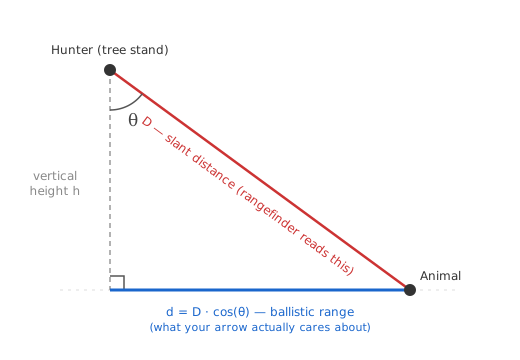
d = D × cos(θ)
D is the slant distance — the direct line from you to the animal. θ is the angle off horizontal. d is the horizontal distance: the number your pins were actually built for.
For a 40-yard slant at 30°: 40 × cos(30°) = 40 × 0.866 = 34.6 yards
For a 40-yard slant at 45°: 40 × cos(45°) = 40 × 0.707 = 28.3 yards
Take it to the extreme to prove the point. You are standing on the edge of a cliff, looking straight down at the target directly below you. The shot angle is 90 degrees. cos(90°) = 0. Horizontal distance: zero yards. Your arrow is not traveling horizontally at all — it is going straight down. Which pin do you use? The math says zero yards. There is no pin for zero yards because on a horizontal shot at zero distance the arrow has not yet left the bow.
Nobody uses their 100-yard pin shooting straight down into a ravine. Nobody sane, anyway. But the same geometry that makes that obviously absurd at 90 degrees is still working against you at 30 degrees — just quietly enough that you blame your release instead of your trigonometry.
A modern bow system is so completely built around horizontal shooting that a nearly vertical shot is not achievable with a normal setup. Every pin you own assumes drop that isn’t happening. The arrow will always hit above your aim point — significantly above. The bow was not designed for that shot.
The diagram shows the geometry. The slant is the line your eye follows to the animal. The horizontal leg is the line the physics follows.
The error — how many inches it costs you
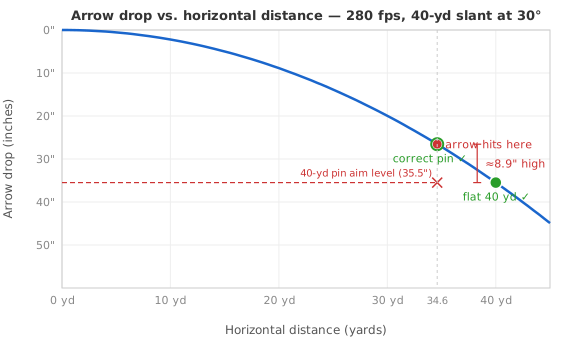
Back to the tree stand. The animal is 40 slant yards, 30° below you. You get a 40-yard reading, so you use the 40-yard pin — the same pin that put arrows through paper at the range all summer. The 40-yard pin was set to compensate for 35.5 inches of drop, because that is what a 280 fps arrow drops at 40 horizontal yards.
The animal is at 34.6 horizontal yards. At that distance, the arrow drops 26.6 inches. The 40-yard pin is waiting to compensate for 35.5 inches that never happen. The pin did exactly what it was supposed to do. You gave it the wrong number.
At 20° — a modest tree stand, nothing dramatic — the error is about 4 inches. Still probably a kill shot on a broadside deer with a clean release. Probably. At 45°, probably disappears:
40-yard slant at 45° is 28.3 horizontal yards. Drop at 28.3 yards: 17.7 inches. The 40-yard pin is expecting 35.5 inches. The arrow hits 17.8 inches above the aim point. On a whitetail that is the back. On a clean miss it is the treetops. You will find the arrow undamaged, which is its own kind of insult.
Ballistic range correction table
Find your shot angle and your slant distance. The table gives you the horizontal distance — the number your pins were actually built for.
| Slant distance | 10° | 20° | 30° | 40° | 45° |
|---|---|---|---|---|---|
| 20 yd | 19.7 | 18.8 | 17.3 | 15.3 | 14.1 |
| 30 yd | 29.5 | 28.2 | 26.0 | 23.0 | 21.2 |
| 40 yd | 39.4 | 37.6 | 34.6 | 30.6 | 28.3 |
| 50 yd | 49.2 | 47.0 | 43.3 | 38.3 | 35.4 |
The boldface entries are the two scenarios above — the shots that produce clean misses after perfect execution, with no obvious explanation on the walk to retrieve the arrow.
Your rangefinder and this problem
A standard laser rangefinder measures slant distance — the straight-line path of the beam. That is the number described throughout this article as the wrong number to put on your pins at steep angles.
Most modern hunting rangefinders have an angle-compensation mode, sometimes labeled TBR (True Ballistic Range), bow mode, or angle mode. In that mode, the rangefinder measures the slant distance and the shot angle, applies the cosine rule automatically, and displays the horizontal distance. The number it shows you is the one that belongs on your pins. Use it directly.
If your rangefinder only measures slant distance, use the correction table above. You can also work out the cosine in your head at full draw in the dying light of November while a shooter buck stands broadside at 38 slant yards on a 25-degree slope. Or you can look at the table before the season and know roughly what your angles cost you.
When the angle matters and when it doesn’t
Below 15°: the correction rounds to less than 1 yard at any hunting distance. A 40-yard slant at 15° is 38.6 yards horizontal — negligible for pin selection. Ignore it.
At 20°: a 40-yard slant becomes 37.6 yards effective — about 4 inches of error with the 40-yard pin. On a broadside deer with a clean sight picture and steady hold, that is borderline. On a quartering animal, in fading light, with any grip tension, it is not.
At 30° and above: the error on a 40-yard shot exceeds 9 inches. Mountain setups, canyon shots, steep tree stand placements — these are not exotic scenarios. A canyon shot at 30° off horizontal is not a steep shot, it is a moderate one. On that shot, using slant distance on your pins means a systematic miss regardless of how cleanly the arrow leaves the bow. You can do everything right and sail over the back, every single time, and never know why.
One more thing worth knowing: uphill shots have the same problem. The cosine rule does not care about direction. A 30° uphill shot at 40 slant yards has the same 8.9-inch error as the downhill version. The correction table works both ways.
The physics does not penalize you for the angle. It penalizes you for using the wrong distance. The angle is just why the two distances are different numbers.
Published 2026-09-13 · Axial Bowstrings