What FOC is
FOC stands for Front of Center. It is the percentage of the arrow’s total length that separates the physical midpoint of the shaft from the balance point. A higher number means the center of mass sits further forward of center. That is the whole definition.
How to measure it
Lay the fully assembled arrow — tip installed, nock installed, vanes on, full hunting or shooting configuration — across a thin edge until it balances. Mark that point. Measure from the throat of the nock to the mark. Measure total arrow length from the same reference point to the tip of the point.
FOC = ((balance-point distance − (total length ÷ 2)) ÷ total length) × 100
Three examples on a 28-inch arrow:
- Balances at 15.75″: (15.75 − 14) ÷ 28 × 100 = 6.25% — low
- Balances at 17″: (17 − 14) ÷ 28 × 100 = 10.7% — adequate for indoor target
- Balances at 18.5″: (18.5 − 14) ÷ 28 × 100 = 16.1% — hunting range
Measure after every component change. A different insert, a different nock, a heavier tip — all move the number. If you want to predict FOC before building, the Easton FOC Calculator (eastonarchery.com/foc-calculator/) runs the calculation alongside spine recommendations. Axial also has a browser-based FOC calculator with a reverse mode — enter a target FOC and it tells you the shaft GPI you need to hit it.
What FOC actually controls
An arrow is a fin-stabilized projectile. The vanes generate a restoring force: when the arrow yaws or pitches away from its flight axis, the vanes catch the airstream and push the tail back. This only works because the center of mass sits forward of the aerodynamic center. FOC is what puts it there.
More FOC means a stronger restoring force when the arrow is disturbed. That restoring force has two consequences, and they point in opposite directions.
Effect 1 — oscillation damping. Every arrow leaves the bow oscillating. For field points this is mostly a tuning concern. For fixed-blade broadheads it matters more: the blades will steer in response to any wobble. Faster oscillation damping means fewer wobble cycles and less opportunity for the broadhead to redirect the arrow. This is the benefit FOC advocates are correctly identifying.
Effect 2 — crosswind weathercocking. The same restoring force does not distinguish between a post-launch oscillation and a sustained lateral push from the wind. In crosswind, a higher-FOC arrow tracks the wind more aggressively. The nose leads into the gust. In outdoor conditions where wind varies shot to shot, this spreads groups.
Why those two effects produce a ceiling
The damping benefit does not grow indefinitely. There is a finite amount of oscillation energy in any arrow launch, and once FOC is high enough to damp it quickly, additional FOC does less and less. The benefit follows an exponential saturation curve — large gains early, shrinking returns as FOC rises, approaching a hard maximum.
The crosswind cost has no such ceiling. It grows linearly: every additional percent of FOC adds the same increment of crosswind sensitivity, all the way up.
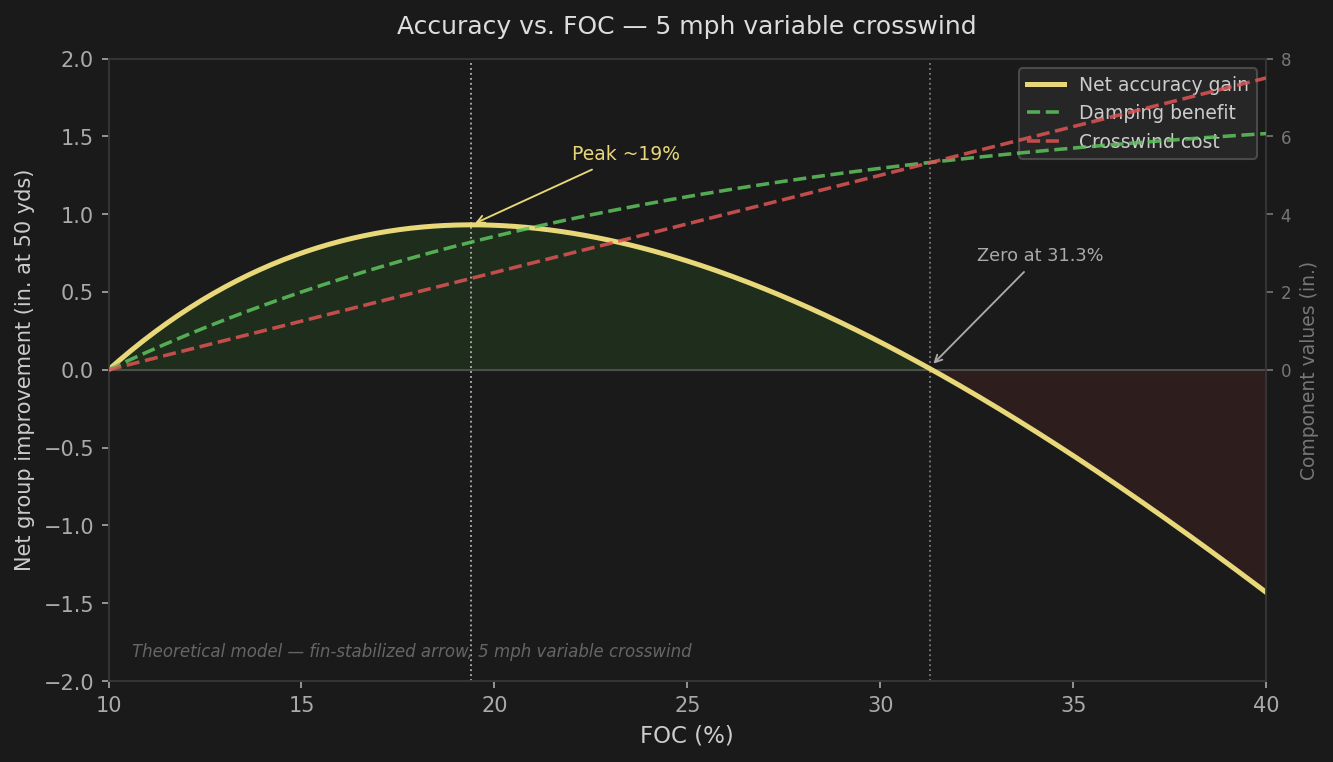
When a diminishing curve meets a constant slope, they cross. The damping benefit and the crosswind cost cross at 19–20% FOC. Below that point, adding FOC nets positive — the damping gain exceeds the crosswind cost. Above it, the math reverses. Past 20%, every percent of additional FOC makes outdoor groups larger.
The marginal return table makes this precise:
| FOC range | Damping gain | Crosswind cost | Net per step |
|---|---|---|---|
| 15% → 16% | +0.33″ | −0.25″ | +0.08″ ✓ |
| 17% → 18% | +0.28″ | −0.25″ | +0.03″ ✓ |
| 18% → 19% | +0.27″ | −0.25″ | +0.02″ ✓ |
| 19% → 20% | +0.25″ | −0.25″ | 0.00″ breakeven |
| 20% → 21% | +0.23″ | −0.25″ | −0.02″ ✗ |
| 22% → 25% | +0.57″ | −0.75″ | −0.18″ ✗ |
| 25% → 30% | +0.73″ | −1.25″ | −0.52″ ✗ |
The damping gain column shrinks with every row — exponential saturation. The crosswind cost column is constant — the linear relationship with no ceiling. The crossover is mechanistically inevitable because the two underlying physics are different in kind.
The zero crossing — where net outdoor accuracy returns to exactly the 10% FOC baseline — falls at 31.3% FOC. An archer who builds a 31% FOC setup has done everything the high-FOC playbook prescribes, paid every associated trade-off, and arrived at the same outdoor accuracy as a standard minimally-stable arrow. Not better. Identical. Past 31%, accuracy is measurably worse than where they started.
The drift cancellation effect — a second variable
The analysis above treats crosswind weathercocking as a single cost: the arrow tracks into the wind and lands off-target. That is accurate as far as it goes. But crosswind does a second thing simultaneously: it pushes the entire arrow body laterally. Bulk drift moves the arrow left. Weathercocking pulls it right. They are opposing forces on the same axis.
This creates a cancellation point. At low FOC, weathercocking is weak — bulk drift dominates, the arrow slides left with the wind, and the group centers off-target. At moderate FOC, weathercocking grows until it exactly cancels bulk drift — the group centers on the face without a wind hold. At high FOC, weathercocking overshoots — the arrow is off-target again, now in the opposite direction.
This looks, on first read, like an argument for pushing FOC higher: center the group without adjusting for wind. That description is accurate for where the group centers. It is not accurate for how large the group is.
Bulk drift cancellation only operates on mean wind speed. Shot-to-shot variation — the gusts and lulls that define real outdoor conditions — drives groups independently. Higher FOC amplifies the weathercocking response to each variation. The center lands on target, but every gust swings the arrow further from that center than it would at lower FOC. The group is larger even when its center is correct. At lower FOC, variation produces a smaller weathercocking swing and tighter groups — but the center drifts because bulk drift wins. That trade-off is not resolvable by adding more FOC. It is a direct consequence of what FOC controls.
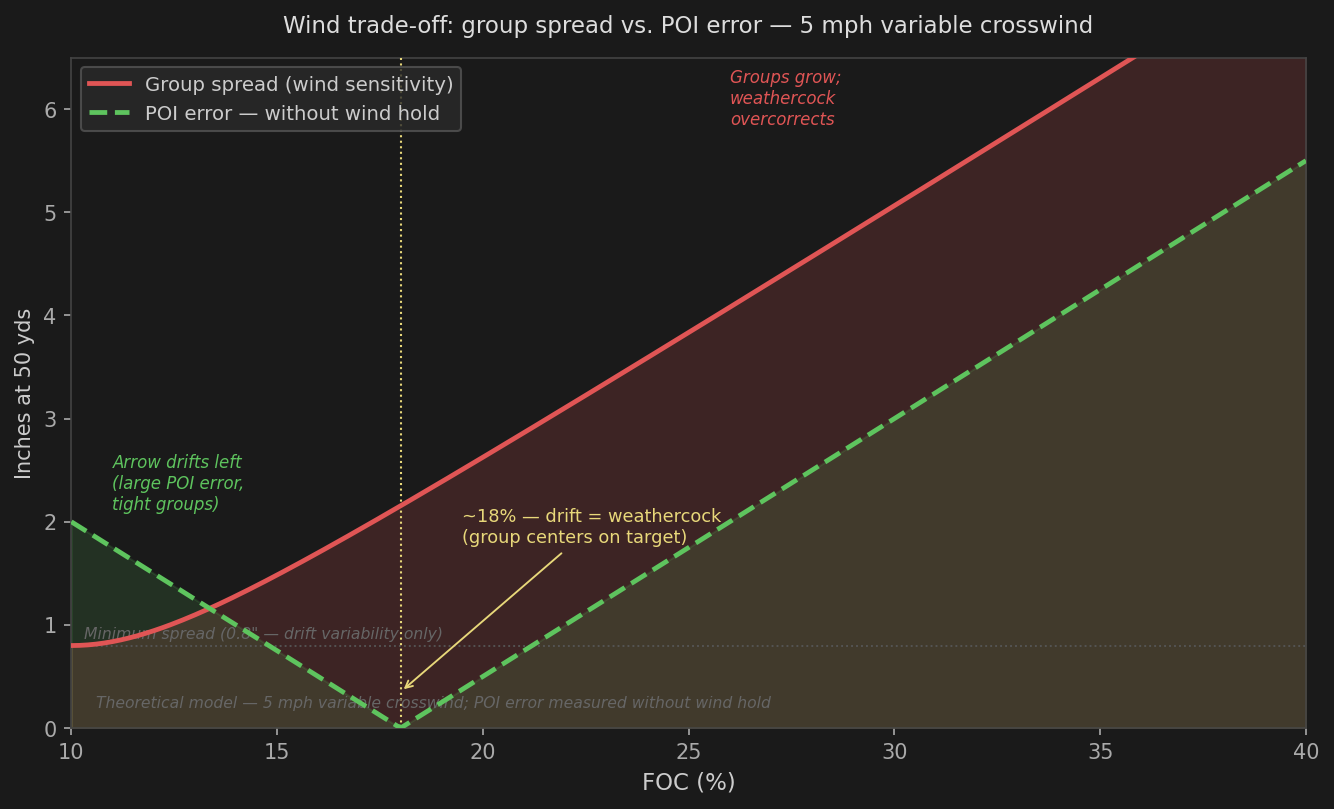
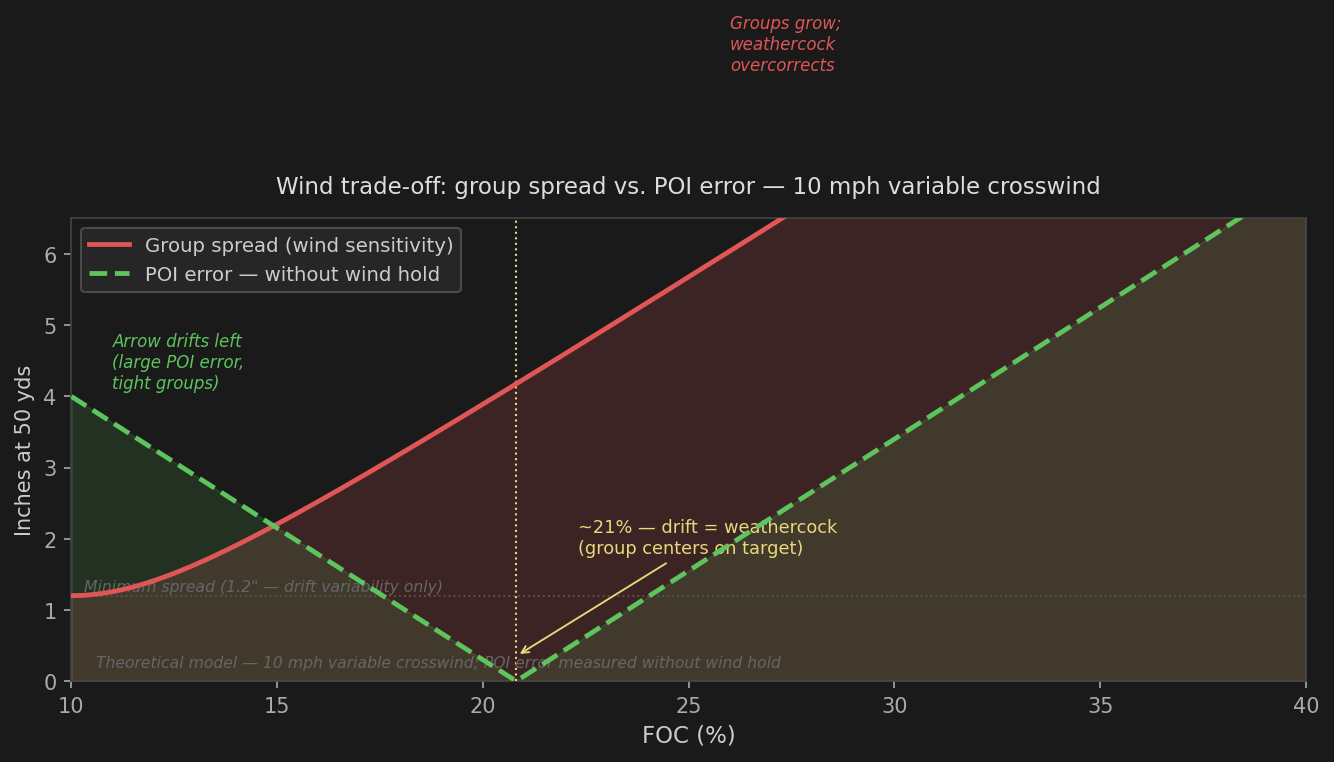
A note on the model: The math above produces a cancellation point — an FOC value at which weathercocking exactly offsets bulk drift and POI error reaches zero. That is what the equations resolve to under idealized assumptions. In practice, real shooting conditions are unlikely to produce a true zero-drift result. Arrow flight involves variable launch angle, imperfect fletching contact with the airstream, and wind that is never perfectly steady or perfectly perpendicular. Weathercocking reduces drift; whether it fully cancels it at any real-world FOC is a more complicated question. The charts are best read for their direction and relative shape — drift falls as FOC rises, group spread rises with it — rather than as precise predictions of the exact cancellation point.
Where the number should land
For indoor target shooting: 10–15%. Crosswind is not a factor indoors, so neither the weathercocking cost nor the drift cancellation dynamic applies. A modest FOC ensures clean oscillation correction after launch. No need to push higher.
For broadhead hunting outdoors: 15–18%. This range captures the meaningful oscillation-damping benefit for broadhead control without crossing into the penalty zone. Two separate analyses converge on the same ceiling from different directions. Easton’s published guidance lists 10–15% for general hunting use, which covers field-point and mixed-purpose setups. The upper portion of this range — 15–18% — applies specifically to fixed-blade broadheads, where faster oscillation damping during the first moments of flight matters more and justifies the modest additional weathercocking cost.
The first analysis — damping benefit versus crosswind weathercocking cost — shows the net return per added percent of FOC thinning to near zero by 18–19% and reversing at 20%. The crosswind cost is linear with no ceiling; the damping benefit saturates. They cross at 19–20%.
The second analysis — drift cancellation versus group spread — shows that the FOC at which bulk drift and weathercocking cancel on the target face falls at roughly 18% in 5 mph conditions. That point is not a sweet spot. It is a transition: below it, the group is tight but off-center; above it, the group grows faster than the centering benefit. The point where both problems are simultaneously worst is directly above the cancellation line.
Both analyses place the ceiling at 18–20% FOC. Below that range, meaningful gains are still available. At the ceiling, both curves break even or reverse. Past it, every added percent costs more than it returns — in net outdoor accuracy and in group size — whether the wind is corrected for or not.
Why the forums keep reaching the wrong answer
High-FOC arrows shot indoors in still air do produce tighter groups. Without crosswind, the weathercocking cost disappears entirely and only the damping benefit remains — so a high-FOC arrow genuinely does group better indoors. That effect is real, measurable, and repeatable. People observe it, conclude the physics is self-evident, and stop testing.
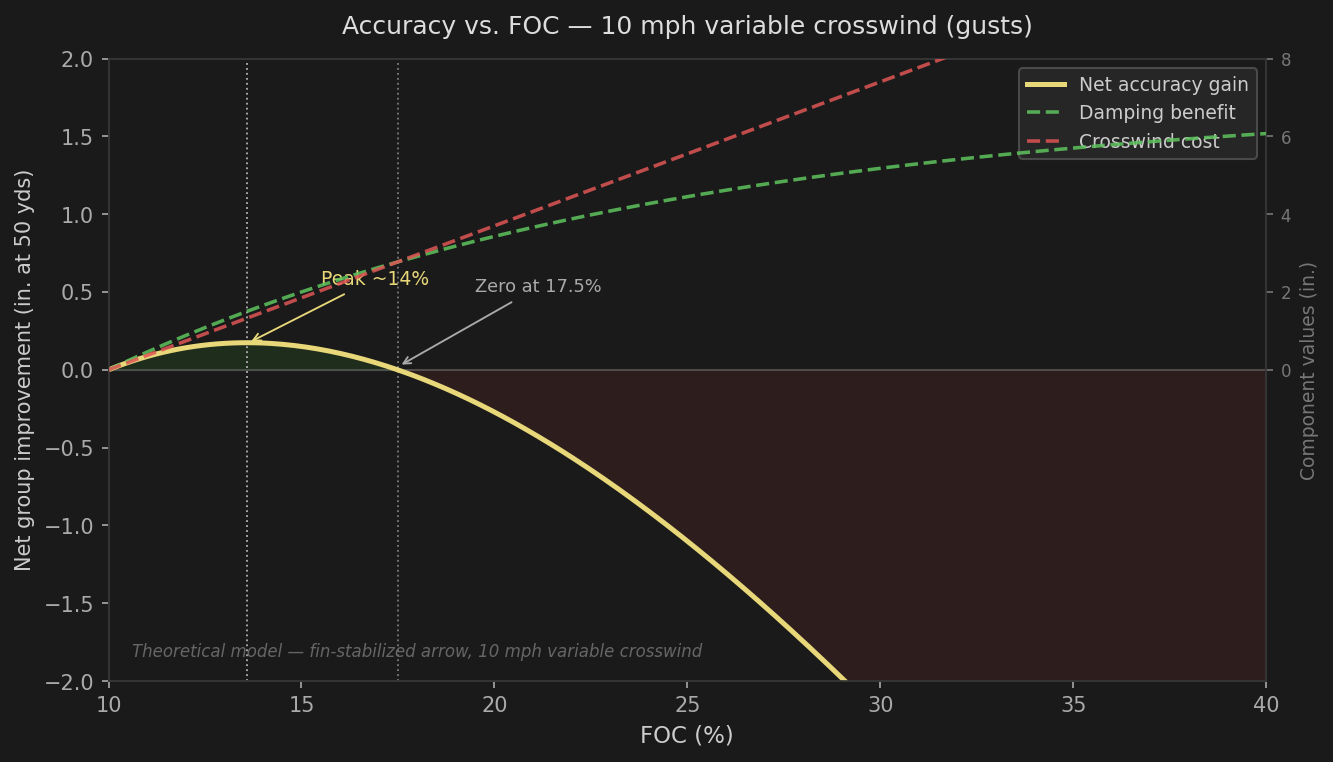
The crosswind cost is invisible indoors. Take those same arrows outside into five miles per hour of variable wind, and the indoor advantage collapses. The damping benefit gets spent paying the crosswind penalty. The test that seemed to confirm the theory was run in the only conditions that could not reveal the tradeoff.
The second source of confusion is that FOC and arrow weight move together when the easiest way to raise FOC is adding tip mass. The two variables get treated as one. They are not. FOC governs flight stability and broadhead accuracy. Total mass governs momentum and penetration. A 600-grain arrow with mass spread evenly along the shaft might have 8% FOC. A 400-grain arrow with a heavy brass insert might have 18% FOC. They will not behave the same at broadhead distance — and the difference will run in the opposite direction from what total weight alone would predict.
The archer who chases FOC past 20% has optimized the variable that did not need more optimizing, and neglected the one that did.
Published 2026-09-06 · Axial Bowstrings
Spotted something? Think we’re wrong? Suggest a correction →
Sources
- Easton Archery — Arrow FOC Calculator. eastonarchery.com/foc-calculator/
- AMO Standard FOC Formula — Archery Manufacturers and Merchants Organization.