Walk-back tuning is one of the most widely shared compound bow tuning methods. It circulates in videos, online guides, and pro shop instructions as a standard step in the tuning process. The method has a logical structure, it is easy to understand, and when conditions are right it can land on a correct center shot position. None of that makes it the right tool for a compound bow.
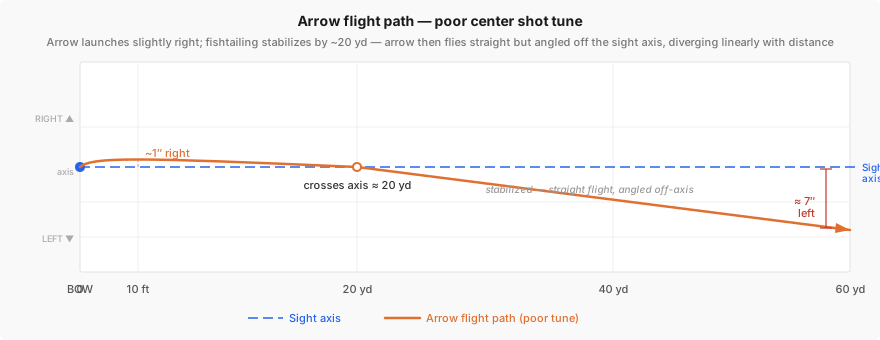
Walk-back came from recurve archery. On a recurve, the archer uses fingers on the string, and a poorly fitted arrow will kick sideways off the pressure point as it leaves the bow — a phenomenon called archer's paradox. That lateral kick compounds with distance. Walk-back was designed to detect that compounding error: aim at the same point from multiple distances, watch the arrows walk sideways, adjust until the walk stops. On a recurve, this is a meaningful diagnostic because the lateral launch error is the natural consequence of how the bow and arrow interact at the shot.
On a compound bow with a mechanical release aid, the string departs straight. There is no finger pressure, no lateral kick, no archer's paradox. The physics that make walk-back useful on a recurve simply do not apply.
What walk-back actually detects on a compound bow
When compound archers run walk-back and see a horizontal walk, the most common causes are not what the method was designed to find:
Gross center shot error. If the rest is far enough off that the arrow is launching at a meaningful horizontal angle to the sight axis, walk-back will show it as a walk. But a bow that far off center shot will also produce a clear horizontal tear on paper and a clearly offset bare shaft. The error was already visible through better tools before walk-back was run.
Second-axis error. Second axis is the tilt of the sight from vertical — if the sight is canted laterally relative to the bow, the pin appears to be at the correct horizontal position at 20 yards but describes an arc as distance increases. The arrows walk. This is a sight alignment problem, not a rest position problem. Walk-back cannot distinguish between a rest error and a second-axis error. An archer who chases a second-axis walk by moving the rest has misdiagnosed the cause and introduced a new rest position error into a bow that was previously correctly tuned.
Grip torque. Horizontal impact variation that grows with distance can also be an inconsistent grip producing a lateral arrow launch bias. Walk-back will show this as a walk. Moving the rest in response to an inconsistent grip tunes the bow to the archer's error rather than correcting it.
The method
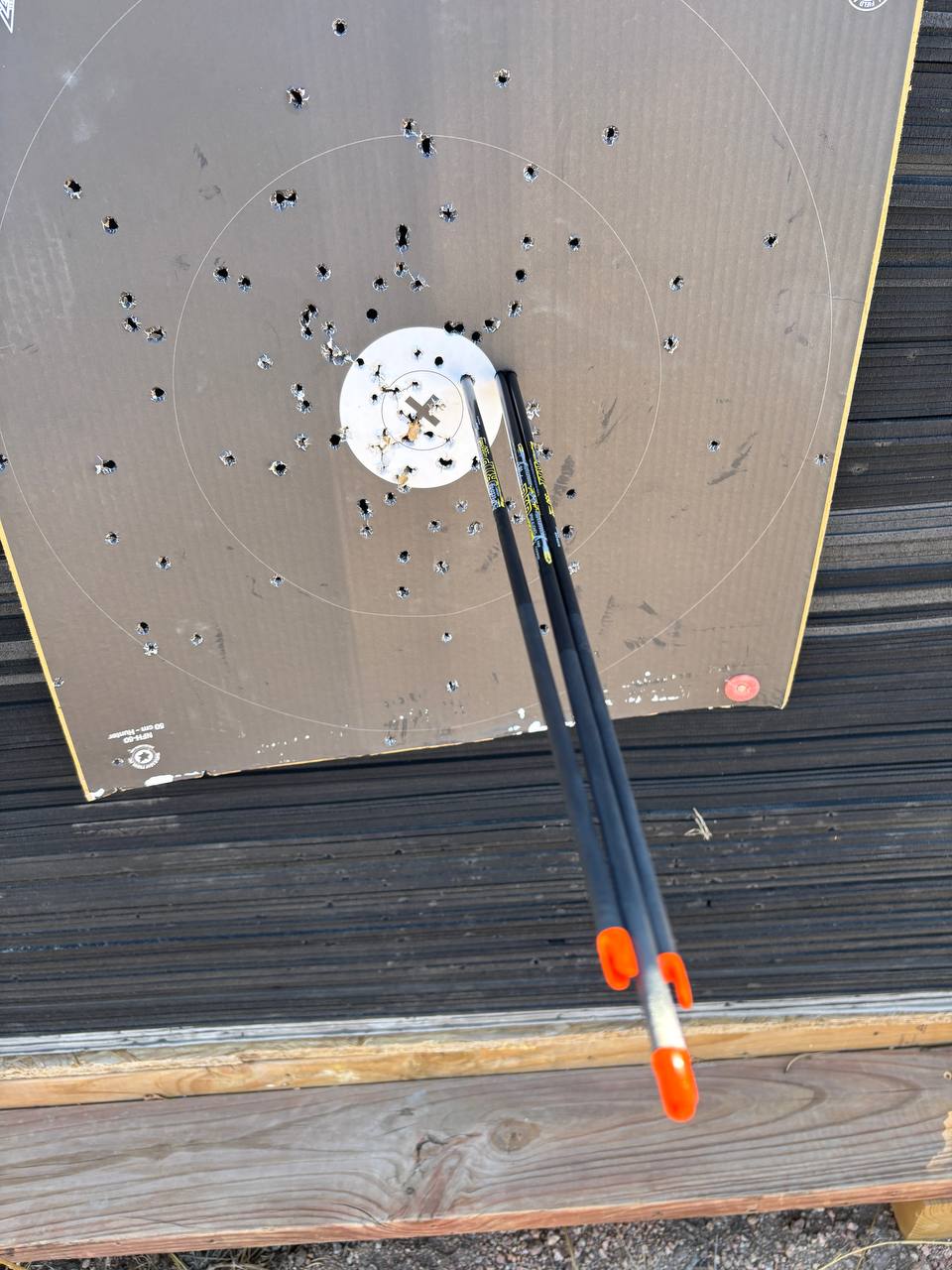
For reference: the walk-back method works as follows. You aim at the same point from 10, 20, 30, and 40 yards using the same pin, without adjusting the sight between distances. You watch whether the arrows form a vertical column or walk horizontally with distance. If the arrows walk right, the correction is to move the rest right. If they walk left, move the rest left.
This correction direction is the opposite of sight-adjustment logic and is the most common source of confusion when archers first use the method. On a sight, you move toward the arrow to correct. On walk-back, you move the rest toward the walk direction. Different tool, different rule.
Why bare shaft and torque tuning are the better approach
The problem walk-back is trying to solve — horizontal alignment between the arrow's launch direction and the sight's aiming axis — is already addressed by two other steps in the tuning sequence, directly and without the ambiguity that walk-back introduces.
Paper tuning catches gross horizontal errors before the arrow ever goes downrange. A significant center shot error produces a clear horizontal tear. Correcting it at the paper stage means that by the time you are shooting at 20 yards, the bow is already in the working range where walk-back would begin to show any signal.
Bare shaft at 20 yards confirms that the paper tune result holds at distance and that the arrow is launching cleanly. A bare shaft that is landing within a few inches of the fletched group means the horizontal geometry is correct. No further center shot diagnostic is needed.
Torque tuning addresses the grip-variation component directly — shooting groups with intentional grip variation to find the torque-neutral position and adjusting the sight, not the rest, to center the group. This is the right tool for the problem that walk-back often ends up chasing.
If those three steps are done correctly, walk-back has nothing left to find. If walk-back produces a result that contradicts bare shaft and torque work, the walk-back result is picking up a confounding variable — second-axis error being the most likely — rather than a new genuine finding.