Introduction — three archers on the line
You step up to the line between two archers at the target range. A clean row of yellow, red, and blue faces greets you — nothing but simplicity.
The guy on your left goes to full draw. Just as you think the shot is about to break, his shoulders drop together, the arrow starts to run away, he pulls it back, and he shakes through the shot.
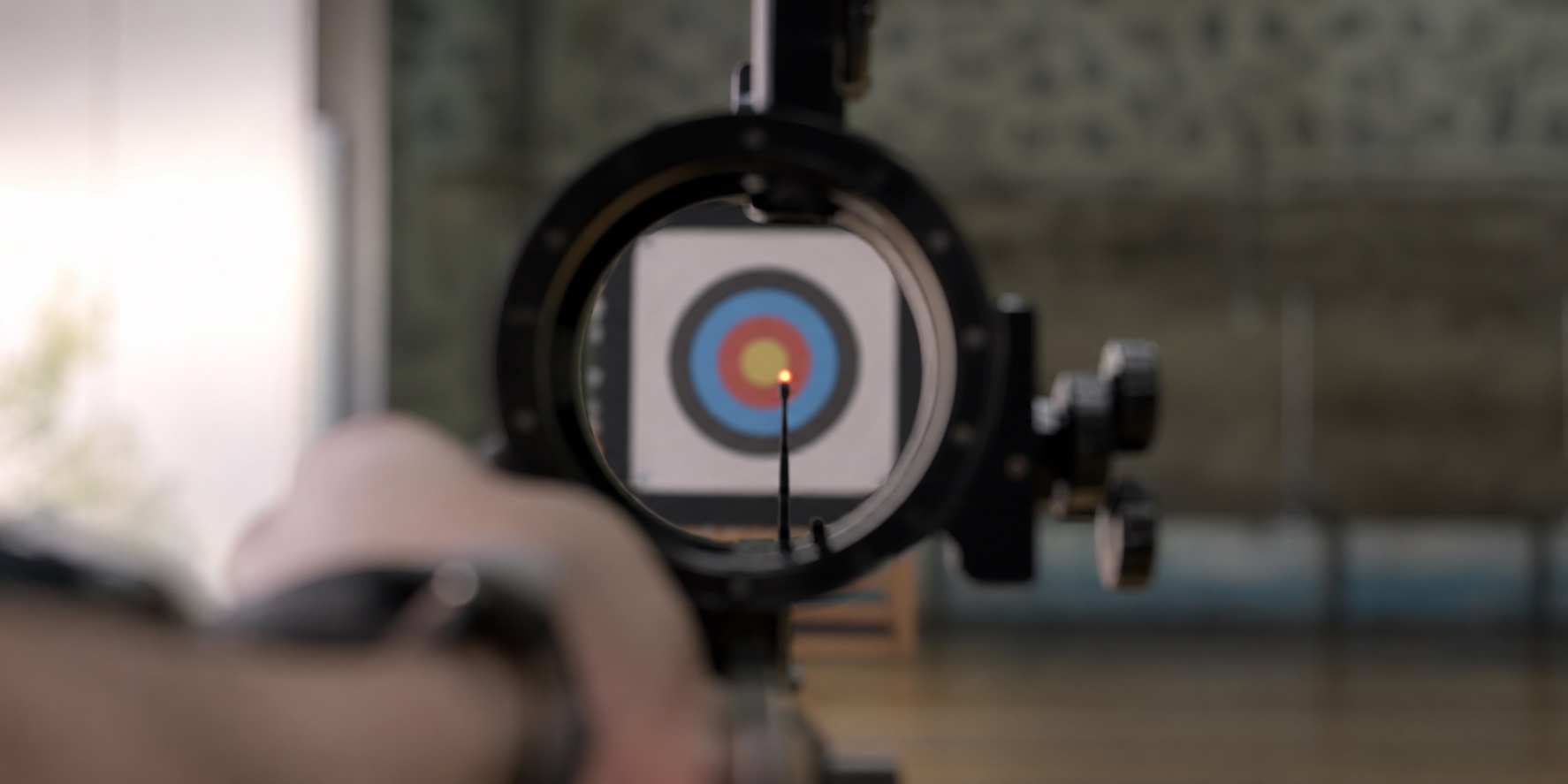
The girl on your right draws her bow, puts the scope on the target, and right as the peep crosses in front of her eye, the shot goes off. A three-second shot sequence, start to finish.
You draw your own bow, thinking this target looks simple — nice and big. But something is wrong that you have never encountered before. The pin just stays low. No matter what you do with your arm, it will not move up. Finally you get tired, force it upward, and slap the trigger when it passes by.
All three of these are versions of target panic.
The guy on your left has anticipation — the most common presentation. His body is pre-activating the muscle pattern for the shot before it actually happens: bracing, tensing, or relaxing in preparation for a cue it now expects. This is the visually obvious version. The best cross-domain picture is a pistol shooter dry-firing on an empty chamber and twisting the pistol down toward the ground — the body has committed to a recoil that isn't coming.
The girl on your right fires the shot the instant the peep aligns with the scope housing. Her mind has paired that visual cue with the trigger action so many times that the pairing has become automatic. She is not choosing to fire — the shot is choosing itself. That is target panic too, even though the shot may still land in the middle.
And you — you have been shooting fine for hundreds, maybe thousands of shots, and this one is different. There seems to be a physical barrier keeping the bow arm from settling into the right position. It is not physical. It is a mental refusal to let the pin sit in the middle, tied to some low-grade anxiety about the shot breaking, or about where the arrow will land, or about both.
Target panic, in every one of these forms, is incredibly prevalent in the precision-sport world.
The short version
Target panic is what happens when the brain learns that arrow-release is a high-arousal event and starts firing a pre-flinch program before the shot goes off. It is universal in every precision sport that has a release event at the end of an aiming task — golf, pistol, darts, cricket, gymnastics. It is not weakness, not a form problem, and not solved by better equipment.
The archery world offers two schools for fixing it, and both are legitimate. One school hides the moment of ignition from the shooter so the pre-flinch has nothing to fire against — this is the surprise-shot family. The other school lets the shooter consciously choose the moment of ignition and trains the pre-flinch out of the small window around that moment — this is the command-shot family. Almost every named modern archery coaching program you have heard of sits in the surprise-shot family. The goal is obvious: keep the subconscious from knowing exactly when the shot will fire, so it cannot prepare for it. The command-shot family is smaller, less institutional, and has produced fewer household names. In some archery circles it is actively discouraged. In pistol and rifle, both approaches have long histories, and commanded ignition is not treated as heretical the way it often is inside the compound-archery world.
This article is not the argument for either school. This article is the ground the argument sits on — what target panic actually is, what it isn't, and what the practical intervention paths look like — before anyone starts prescribing a specific fix.
The yips family — target panic is not alone
In the sports-psychology literature the umbrella term for this class of breakdown is the yips. It was first named in golf, where a putter suddenly cannot execute a stroke they have executed ten thousand times before. The same phenomenon shows up in darts (called dartitis), in baseball pitching (called Steve Blass disease, after the pitcher who lost his release-point control mid-career), in cricket bowling, in snooker, and in archery. Different sports, different motor patterns, same signature: a well-trained, previously automatic movement suddenly fails to run cleanly, and the failure is not corrected by more practice of the movement itself.
Researchers now split the yips into two sub-types, and both show up in archers:
- Type I — a neurological presentation resembling focal dystonia. Jerky, involuntary movements. Twitches, spasms, tremors that feel mechanical in origin and disrupt the physical execution of the skill. In archery this typically presents as a dip of the bow arm, or a collapse in the back tension, in the moment before the shot breaks. What has fired early is the body — the frame has braced against an impact that has not yet happened, and the arrow leaves a bow that is already moving.
- Type II — a psychological or cognitive presentation. Hesitation, overcontrol, loss of rhythm, freezing off-target, inability to complete the release. Not mechanical spasm, but cognitive interference that stops the automatic motor program from running to completion.
Most archers with target panic have some blend of both. The freeze off-target is Type II. The bow-arm dip or back-tension collapse as the pin approaches center is Type I. Type I typically emerges after Type II has been present, untreated, for long enough that the brain has built a hard-wired anticipatory bracing pattern out of what was originally a cognitive hesitation. The important consequence: the two subtypes require different training responses, and treating a Type II freeze as though it were a Type I twitch (or vice versa) is a fast path to making the condition worse.
The mechanism — task focus becoming outcome focus
The core finding across yips research, choking research, and the more recent twisties research (the gymnastics variant of the same phenomenon) is that these breakdowns share one signature: an attentional shift from the task to the outcome, and from the automatic motor process to conscious monitoring of that process.
A well-trained motor program runs cleanly when the athlete is focused externally — on the target, on the movement's effect on the world, on the arrow's flight rather than on the release finger. The same program runs poorly when the athlete becomes focused internally on the movement itself and on whether it is going to work. This is Gabriele Wulf's constrained-action hypothesis, and it is one of the most replicated findings in motor learning research: external focus produces better and more automatic movement; internal focus disrupts it. External thoughts take you out of the shot sequence, which is usually not great for precision aiming — but they are also, and this matters, better than internal thoughts about how the release finger is doing.
Sian Beilock and colleagues extended this line of work to choking under pressure. Their finding: pressure causes athletes to attend to skills they normally execute automatically, and that attention actively interferes with the skill. The technical term is skill-focused attention. The practical translation for archery: when the archer starts thinking about the release finger, or about whether the shot is going to break cleanly, the release finger stops behaving the way it did in practice. The thought itself is what breaks the movement.
Anticipatory anxiety and the pre-ignition motor program
The specific mechanism that turns ordinary bad shooting into a chronic target-panic condition is anticipatory anxiety. The body learns, over hundreds and then thousands of shots, that the moment of arrow-release is a high-arousal event. There is muscle tension, noise, recoil into the bow hand, and the psychological weight of watching the arrow leave — the outcome the archer has been aiming toward is now committed and unrecoverable. The nervous system does not distinguish between the emotional stakes of a target arrow and the survival stakes of a startling event; it treats both as arousal spikes to be prepared for.
Given that categorization, the brain does what it is designed to do. It begins running a pre-ignition motor program: bracing, tightening, or flinching, all in anticipation of the event before it happens. In the healthy case, this program is small and unnoticed. In the target-panic case, it becomes large enough to hijack the shot. The brain is very good at predicting the near future and preparing you for it — that talent is what target panic is exploiting.
This is the same mechanism that produces the pistol flinch that new pistol shooters have to unlearn. It is the same mechanism behind the golfer's putting yips. It is the same mechanism behind the twisties in gymnastics — at a nervous-system level, an anticipatory motor program interfering with an automatic aerial sequence. In each case, the body has learned to react to an event before the event occurs, and the reaction destroys the movement.
The archery-specific version simply has an unusually clear firing point. The pin approaches the middle. The brain has learned that the pin approaching the middle is what precedes the release. The pre-ignition program fires against that cue — either as a physical brace against the anticipated impact (Type I: bow arm dipping, back tension collapsing) or as a freeze that prevents the cue from ever completing (Type II). Both are the same underlying wiring expressed in different directions.
What this rules out
Reading target panic through the sports-science literature rules out several explanations that are common in archery folklore. Each one, when believed, sends the archer looking for the wrong fix.
Target panic is not a character defect. It is not weakness, cowardice, or a lack of mental toughness. Every athlete performing a repeated aiming task with a release event at the end will develop some version of it. Nothing in the target-panic literature suggests the condition can be willed away.
Target panic is not an equipment problem. A different release aid, a heavier stabilizer, a lower draw weight, a different grip — none of these change the underlying wiring. They can shift the surface presentation of the symptom, sometimes dramatically, which is why archers experience temporary relief when they switch equipment. But the anticipatory motor program remains, and it re-attaches to the new configuration within a few hundred shots. Any archer who has switched to a hinge release and had the yips return within a month has experienced this directly.
Target panic is not a form problem. An archer with clean form and target panic will not shoot better by working on their form. The form is fine. What is broken is upstream of the form — it is in the wiring that decides when the automatic program is allowed to run. Form drills that do not address the wiring produce cleaner, better-executed target-panic shots.
Target panic is not caused by aiming at the middle. This one is subtler, but it matters. The brain does not have target panic because the target is difficult; it has target panic because a specific cue in the archer's practice history has been paired with a high-arousal event enough times to build a conditioned response. That cue is usually the sight picture on the middle, but it does not have to be. Archers who have retrained around the pin-on-center cue can develop target panic against different cues — the sound of the bow, the moment of full draw, the peep aligning with the sight housing. The condition is about pairing, not about the middle of the target specifically.
The two families of solutions
The intervention literature does not agree with the archery world that any one method is the answer to target panic. It endorses two broad families of solutions, and both are represented in the debate the archer is walking into.
Both families are legitimate. Both have produced accurate archers. The archery world has, for historical reasons, gone hard on family one — nearly every named coaching program in the sport sits inside it in some form. That does not settle the debate. It just settles the market.
Cures
There is not necessarily a cure for target panic, because it is a natural neurological phenomenon rather than a disease. What there is, is a set of methods that keep target panic from interfering with the shot. The four sections below are short, direct starting points — one for each combination of type and family. We suggest working with a coach before attempting any of them.
First, decide whether you are going to resolve the issue with a family-one or family-two approach. Then identify which type of yips you are actually working on. The four combinations below cover the practical intervention paths.
Type I, family one — spasms, resolved via surprise
Focus on learning surprise-shot release execution. Any release aid works if you know how to shoot it in a surprise fashion. On an index release, the finger wraps around the trigger to a point just short of firing — then back tension is applied to pull the release out of the hand, without the trigger finger adding pressure. The pull does the work. The finger is only holding position.
Reduce your bow poundage and strip unnecessary weight off the bow. At 20 yards, draw and hold on a target that is easy for you to hit — a six-inch dot with no X-ring, or a balloon. We are not training accuracy here. We are training a shot sequence.
Work the sequence as slow as you can. It should feel, at first, like you are just waiting and waiting for it to go. That waiting is the point. That waiting is what you are trying to keep in your shot sequence forever. The training goal is to narrow the waiting window, through repetition, to less than a second — while keeping it truly a wait, not a countdown.
There is no fixed amount of training. It takes as long as it takes for that small waiting window to feel like a normal, permanent part of the shot.
Type II, family one — aiming freeze, resolved via surprise
The goal is to break the connection between the sight picture and the shot event.
The tool is blank bailing. Use a large target with no aiming point, placed extremely close — five yards, or less. Some people remove the sight from the bow entirely for this stage. Preserving the sight is preferable, because it keeps the long-term visual image intact, but either approach works.
This is a long process. You should not compete during it, and ideally you should not shoot anywhere else during it either. We are retraining the brain, and reinforcement of the old shot every weekend will delay or prevent that retraining.
The drill combines with the family-one Type I work above. Blank bail at very close range while executing the surprise release sequence — slow, wait, wait, break. It should feel, again, like you are just standing there at full draw waiting for the shot to go. That is the correct feel.
This does two things at once. It occupies the mind with surprise-release training, and it lets you complete a shot sequence without the sight-picture-to-impact stress the panicked archer has been living with. Over time — weeks or months, not days — the sight picture stops being paired with the shot event. The brain has fired the shot enough times without that pairing that the pairing weakens and, eventually, dissolves.
Once the pairing is gone, walk the bail slowly farther back, then reintroduce a small target and shrink it over time. You are rebuilding the aiming task on top of a shot sequence the brain no longer panics about.
Type I, family two — spasms, resolved via command
First, separate command from punching. Punching the trigger is never recommended, and the punchiness has to come out of the shot before this method can begin.
Record the release hand in slow motion for a few shots. The video should show you settling into position, moving onto the trigger, working it slightly, and — in the moment before the shot breaks — the finger moving less than 1/32" to complete the ignition. If the finger is floating and then slapping down onto the trigger, resolve that first. That is punching, not commanding.
If more than the finger is doing the triggering — if you can see the whole hand tense at the break — work on the exercises below before continuing.
The muscles of the hand are interconnected. When you try to move one, others often move with it. That coupling is natural. What can be trained out is the further recruitment of muscles up the arm and into the body that fire alongside a small finger movement.
Hold your relaxed hand in front of you and try to move just the index finger quickly. You will likely see the whole hand move, and even the bicep fire. That is the underlying problem in miniature — one muscle firing triggers a cascade of others. Now do the same finger movement slowly, and much smaller. The cascade will be much less pronounced, or gone entirely. That is the key to a successful command shot: the final effort is small enough that it does not recruit the rest of the body.
Practice these tiny finger movements both at rest and during shooting. The smallest possible movement should finish the shot. You should not see the middle finger move during index-release execution, or the index finger move during thumb-button execution.
There is a second issue underneath the finger twitch. Many archers also carry a full-body flinch, or a bow-arm twitch bracing for the shot impact, that fires at the moment of release. There is no fully proven method for desensitizing that reflex. In the pistol world, the standard tool is dummy rounds — if you flinch on the dud, you fail the drill. That drill's only actual function is to make the flinch visible to the shooter, so the shooter can note it and work on it.
Archery does not have a clean equivalent. A dry fire is a much worse experience than a dud round, so we cannot use the same trick. What we can do is substitute methods that make the flinch visible.
For archery, the best version of this is to shoot fairly close and work the follow-through. An old-school bow-roll follow-through will hide the flinch — the bow rolling forward can absorb the twitch and disguise it. For this method you want the push-to-the-target follow-through, where the bow keeps driving toward the target after the break. After the shot breaks, keep the pin on the target and keep pushing the bow at it. Repeat, and repeat, and every time the pin ends up nowhere near the target after the break, note internally that you flinched.
Over time the body focuses on the follow-through motion instead of on preparing for the impact, and the pre-ignition recruitment fades. Archery is not an explosion. Make the release part of the process, not the end of it.
Type II, family two — aiming freeze, resolved via command
This is by far the most common area where compound archers have trouble, and it has ended more careers than any other. It typically shows up as the drive-by shooter — the archer whose shot goes off the instant the pin passes through center, on its way to somewhere else.
The key to resolving it is dissociating the pin-on-target sight picture from the arousal spike of the shot. The solution is easy. The method is easy. The reprogramming of the brain is what takes time.
The method is simple. Hold the bow at full draw, sight on the target, and do not fire. Make the mind okay with seeing that image without an event.
Reduce your bow poundage and strip unnecessary weight off the bow. Set up a target that is either a little larger than your normal goal or a little closer. Come to full draw, sight onto it, hold for a solid number of seconds to simulate a normal shot, and let down. Repeat until the sight-on-target picture feels normal without a shot attached to it.
Now use the same target at very close range — five yards. Sight the bow in for that range. Your shot sequence is going to look a little different now.
Come to draw and hold the pin in the middle. At five yards this should be easy. Feel the pin's natural motion. Focus on the motion and play with it. Try to see the shapes the pin traces. Try to influence the shapes. Think about a figure eight, and the pin will roughly trace one. Think about slow counterclockwise circles, and it will roughly trace those. For each shot, before you fire, focus on what the pin is doing and how long it stays on target. Never hold longer than is comfortable — we are not training longer holds, we are training aiming.
Most people at this stage will say some version of: I've never actually aimed. I've always just shot as soon as it looked good. That confession is the correction. We are learning to aim.
Keep moving the target back as you progress, always watching the pin, and never firing the first time the pin hits the middle. We draw. We aim. Then we execute.
Conclusion
Where the archer's method sits inside this map — and what the Axial position is on which family produces a more repeatable shot under match-day stress — is the subject of the next article in this series. This one has done its work if the reader now understands what target panic actually is, why it is universal rather than personal, and why the fixes for it come in two legitimate families rather than one.
Further reading
For readers who want the primary sources:
- Wulf, G. — Attention and Motor Skill Learning (2007). The definitive statement of the constrained-action hypothesis.
- Beilock, S. — Choke: What the Secrets of the Brain Reveal About Getting It Right When You Have To (2010). Accessible summary of the skill-focused attention research.
- Smith, A. M., et al. — a series of papers on the yips in golf published in the Journal of Sports Sciences, establishing the Type I / Type II distinction.
- Wise, L. — Core Archery. The foundational back-tension text in the compound world.
Published 2026-07-04 · Updated 2026-07-05 · Axial Bowstrings