Every arrow oscillates after leaving the bow. A well-tuned setup produces oscillation small enough and fast enough that the fletching damps it before the arrow reaches the target. Porpoising and fishtailing are what happens when that damping fails — or when the initial launch error is large enough that the fletching cannot fully correct it in flight.
The terms come from the motion they describe. A porpoising arrow tips its nock up and down in the vertical plane, like a porpoise surfacing and diving. A fishtailing arrow swings its nock left and right in the horizontal plane, like a fish swimming. In practice you rarely watch the arrow in flight — you read the evidence at the target and in the paper tear.
How to tell them apart
Group shape at distance
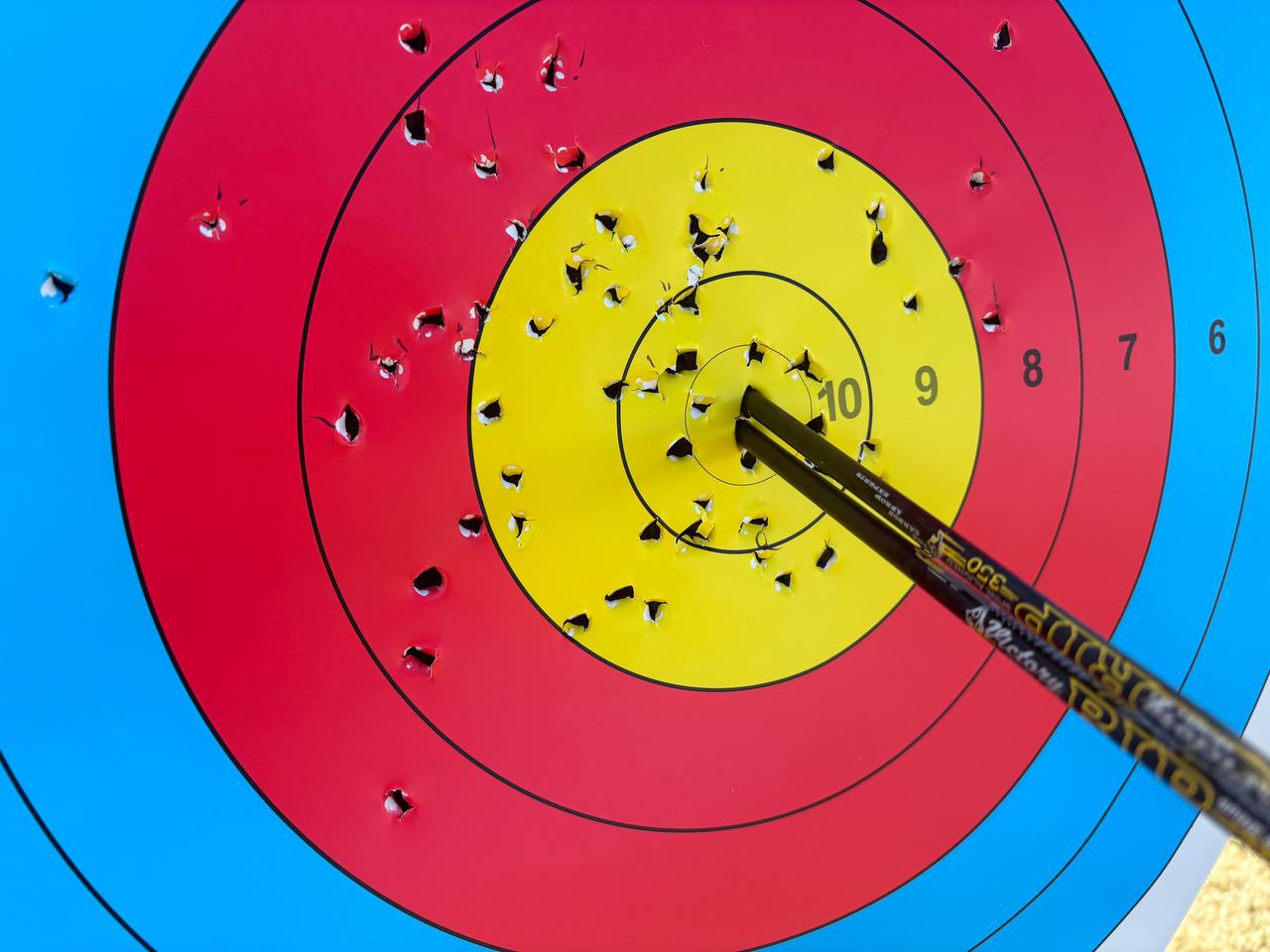
The clearest field evidence is group shape at 30 to 50 yards. Shoot a group of 5 or 6 arrows at a distance where you normally shoot consistently. Step back from the target and look at the group's orientation.
- Vertically elongated group — arrows are spreading up and down but staying horizontally consistent. This is the signature of porpoising. The arrows are arriving with different vertical attitudes, and the randomness of the oscillation phase at impact spreads them vertically.
- Horizontally elongated group — arrows are spreading left and right but staying vertically consistent. This is fishtailing. The nock end is swinging laterally and landing at different points in that swing.
- Random scatter in both planes — the arrow is unstable in both dimensions. This is more severe and usually points to a spine mismatch significant enough that the fletching cannot control either oscillation axis.
Paper tear direction
A paper tear at 9 to 12 feet will show the same axis as the instability. A vertical tear (nock high or low) corresponds to porpoising; a horizontal tear (nock left or right) corresponds to fishtailing. Paper gives you an earlier data point than group shape — the tear shows what the arrow is doing at the deflection apex, before the fletching has had the full flight to either correct or fail to correct the oscillation.
Bare shaft comparison
Shooting a bare shaft (same arrow without fletching) at 20 yards alongside a fletched arrow is the most informative single comparison available. The bare shaft has no self-correcting mechanism. Whatever instability the fletching is masking shows up immediately in the bare shaft's behavior — it will hit the target with its nock noticeably off-center if the bow is producing significant launch error in either plane.
If the bare shaft is off vertically and the fletched arrow groups well, the bow has a vertical launch error that the fletching is successfully damping. At longer distances or with heavier broadheads, that masking will degrade. If the bare shaft is well-behaved and the fletched arrows group poorly, the fletching itself — damaged vanes, inconsistent helical, loose nocks — is the more likely culprit.
Porpoising — causes and fixes
Porpoising is a vertical plane problem. The nock end of the arrow is above or below the tip at the point of oscillation, and this attitude is inconsistent shot to shot. The primary controls for the vertical plane are:
Nocking point height
The most common cause of porpoising. If the nocking point (or D-loop position) is set too high, the arrow launches with the nock end elevated. The arrow tips nose-down to correct, overshoots, and oscillates. Set too low, the opposite happens. Start here. A correctly positioned nocking point puts the arrow slightly nock-high at brace height — roughly 1/8 to 3/16 inch above level for most rest designs — and allows the arrow to travel in a relatively flat arc off the rest.
Arrow rest height
The rest sets the elevation of the arrow's launch point relative to the center of the string. If the rest is set too high or too low independent of the nocking point, the vertical launch angle changes. Adjust nocking point first, then fine-tune rest elevation if vertical groups persist.
Weak arrow spine expressing vertically
An arrow that is significantly under-spined for the draw weight and length will flex excessively on launch. On a compound bow with a well-positioned rest, most of this flex is vertical, driven by the arrow's support point on the rest during nock acceleration at release. But severe spine mismatch can contribute to vertical instability as well, particularly if the rest has any lateral-to-vertical interaction in its timing. If nocking point and rest height adjustments do not resolve porpoising, check the arrow selection against the manufacturer's spine chart for the actual peak weight and draw length.
Cam timing (two-cam bows)
On a dual-cam bow, if the cams are out of sync, the top and bottom limbs do not finish their power stroke simultaneously. The string's departure from one cam is slightly ahead of the other, which can impart a rotational moment to the string at the nock — driving the nock end up or down depending on which cam is leading. Cam timing issues often show up as porpoising that does not respond to nocking point adjustments. Check timing marks before assuming the rest or nocking point is at fault.
Fishtailing — causes and fixes
Fishtailing is a horizontal plane problem. The nock end is swinging left or right, and the arrow is landing at different points in that lateral oscillation. The primary controls for the horizontal plane are:
Arrow spine
On a compound bow shot with a release aid, the string departs straight — there is no lateral string deflection to drive lateral arrow flex. Horizontal instability is therefore primarily a center shot and rest issue, not a spine issue in the traditional sense. An arrow that is badly mismatched in spine will produce overall instability, but the directional left/right logic that applies to finger shooting does not transfer cleanly to a compound with a release.
The spine check that matters on a compound is whether the arrow is within the correct dynamic spine range for the actual peak weight and draw length. An arrow that is severely under- or over-spined will oscillate at an amplitude the fletching cannot fully damp before the target, producing erratic groups rather than a consistent directional drift. Check actual peak weight on a draw board — not the label — against the arrow manufacturer's chart.
Center shot
Center shot determines the horizontal position of the rest relative to the bow's centerline. If the rest is positioned too far left or right, the arrow launches at an angle to the sight's aiming axis. This produces a consistent horizontal drift at distance rather than oscillatory group spread. Walk-back tuning distinguishes center shot error from spine error: walk-back tests the horizontal relationship between sight and launch axis, and a correct walk-back result does not rule out spine error — it rules out center shot error specifically.
Rest timing and fletching contact
A fall-away rest that drops too slowly can contact the fletching during the arrow's departure, imparting a lateral kick. This shows up as fishtailing that appears suddenly after a rest or string change, or is sensitive to arrow length or fletching size. Inspect the fletching for wear patterns on the inner vane — contact marks confirm the issue. Slow-motion video, if available, will show the kick directly.
Nock fit
A loose nock allows the string to slip laterally at the moment of release before the nock disengages. This is a small but real source of shot-to-shot horizontal variation. A nock that requires significant force to seat and release will constrain the string's departure direction more tightly. Nock fit within the string's serving groove matters for the same reason: a nock that rocks on the serving before release introduces angular variation at the one moment the arrow is most sensitive to it.
When both are present
If a bow is producing both vertical and horizontal instability — random scatter in both planes — the most likely cause is a severe spine mismatch, not two separate vertical and horizontal problems. The arrow is simply not stiff enough (or is too stiff) to be controlled by the fletching before it reaches the target at any reasonable distance. In this case, adjusting nocking point and center shot may improve one plane slightly but will not resolve the instability. The arrow selection needs to change first.
The secondary possibility is fletching contact — if the arrow is contacting the rest, riser, or cables on departure, it can be destabilized in both planes simultaneously. Check the fletching for contact marks before concluding the spine is wrong.
Diagnostic sequence
If you are starting from scratch with an unstable bow:
- Shoot a bare shaft at 20 yards. Identify which plane the instability is in — or whether it is both.
- If vertical: check nocking point first. Move it until the bare shaft impact is level with the fletched arrow.
- If horizontal: check spine against a spine chart at your actual peak weight. If spine is correct, confirm center shot position via paper tune and bare shaft at 20 yards; check second axis on the sight before moving the rest.
- If both: verify spine selection before adjusting anything else. Then check for fletching contact.
- After resolving bare shaft behavior, recheck with fletched arrows at distance. Group shape should now be consistent with your remaining form variation, not artificially spread by the bow's launch error.