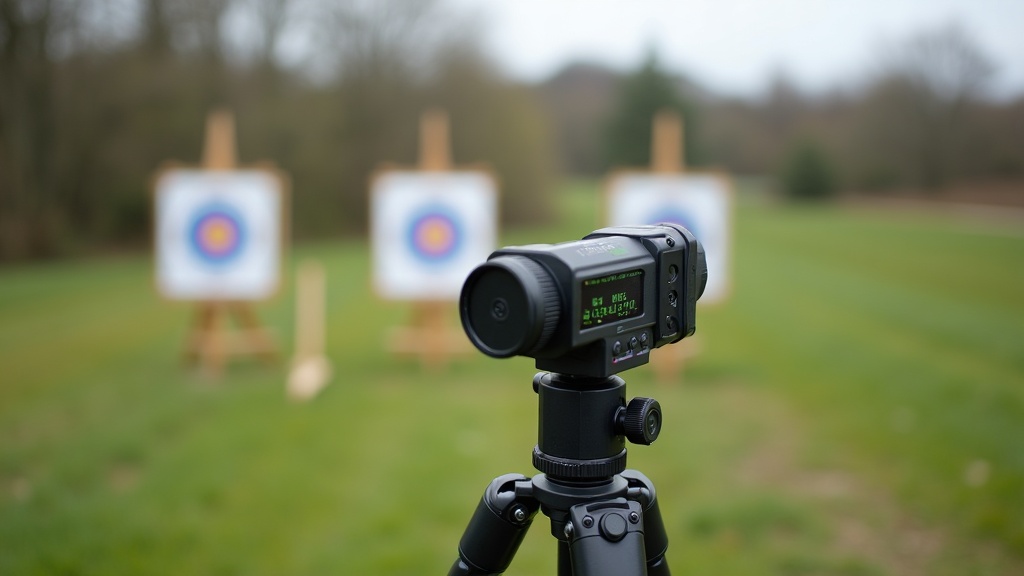
Archers obsess over arrow straightness tolerances, weight-matching to the tenth of a grain, helical versus offset versus straight vanes, numbering arrows to track individual performance, spine charts, and group measurements at every distance. Most of that work is legitimate. And yet the one measurement that ties all of it together — actual arrow speed, shot to shot — is something most archers never take. The chronograph sits in a bag or on a shelf, brought out occasionally to settle an argument about how fast the bow is, then put away again.
Most archers use a chronograph to compare setups — old string vs. new string, one arrow weight vs. another, this bow vs. that one. Those comparisons are useful. They are also the least interesting thing the instrument can tell you.
The more productive use is to point it at a matched set of arrows and shoot them one at a time, in a session, with the same sight setting and the same intent. Not to find out how fast the bow is — you already know that. To find out how consistent the system is. Equipment and shooter, together, shot to shot.
Extreme spread — ES — is the difference between the fastest and slowest shots in that string. A 280, 285, 279, 283, 281 group has an ES of 6 fps. That number has a direct translation to vertical impact at distance, and it doesn't care what caused it.
What ES costs you downrange
A slower arrow spends more time in flight than a faster one. More time in flight means more time under gravity. At the same sight setting, the slower arrow hits lower. The size of that gap depends on the speed difference and the distance to the target.
At 280 fps average, each 1 fps of velocity variation produces approximately the following vertical difference:
| Distance | Vertical shift per fps |
|---|---|
| 20 yards | 0.06″ |
| 40 yards | 0.26″ |
| 60 yards | 0.57″ |
| 80 yards | 1.02″ |
| 100 yards | 1.59″ |
Multiply by your ES to find the vertical window those shots produce from speed variation alone — before form, aim, or anything else enters the picture.
| ES | 20 yd | 40 yd | 60 yd | 80 yd | 100 yd |
|---|---|---|---|---|---|
| 3 fps | 0.2″ | 0.8″ | 1.7″ | 3.1″ | 4.8″ |
| 5 fps | 0.3″ | 1.3″ | 2.9″ | 5.2″ | 8.1″ |
| 7 fps | 0.5″ | 1.8″ | 4.1″ | 7.4″ | 11.5″ |
| 10 fps | 0.7″ | 2.7″ | 6.0″ | 10.7″ | 16.7″ |
At 20 yards, a 10 fps ES contributes less than ¾″ of vertical dispersion. Nobody notices. At 80 yards, that same ES opens a 10-inch window before the shooter touches the equation. At 100 yards it's 16 inches.
These figures use a flat-trajectory approximation at 280 fps. Real trajectories arc, which slightly changes the absolute numbers, but the scale is accurate for practical archery distances and these speeds.
What ES number to aim for
ES from velocity variation should account for less than half your total grouping budget. The tighter the goal, the less ES you can afford.
If you are shooting at a USA Archery 50 m target and want to hold all arrows in the 10 ring, the 10 ring gives you very little room. At that distance, 1–2 fps ES is the target — anything higher starts eating into the margin before form, wind, or aim enter the picture. That number requires matched arrows, consistent nock fit, and repeatable mechanics.
If you are hunting or shooting for fun at practical distances, 10 fps ES is a reasonable place to be. The vertical contribution at 40 yards is under 3″ — not precision competition, but not a limiting factor for most field use.
The obvious culprit isn't always the problem
Arrow weight variation is the first thing most archers blame for high ES. Sometimes they're right. At a 400 grain baseline and 280 fps, one grain of arrow weight costs about 0.35 fps. Five grains of variation across a set produces roughly 1.7 fps of spread — detectable on a chronograph, and meaningful at longer distances.
| Weight difference | Speed change |
|---|---|
| 1 gr | −0.35 fps |
| 2 gr | −0.70 fps |
| 3 gr | −1.04 fps |
| 5 gr | −1.73 fps |
| 10 gr | −3.44 fps |
| 15 gr | −5.11 fps |
| 20 gr | −6.75 fps |
| 30 gr | −9.94 fps |
Baseline: 400 grain arrow at 280 fps. Calculated from the kinetic energy model; actual results vary slightly with bow efficiency and effective bow mass.
If the arrows have already been weighed and matched — same lot, within half a grain — and ES is still running above 3–4 fps, the weight explanation is gone. Something else is varying, shot to shot. The chronograph is measuring it. The job is to find it.
What else varies shot to shot
Nock fit
A nock that fits correctly holds on the string through the draw and releases cleanly at the moment of the shot. A nock that is too tight grips the string and requires force to release — energy that should accelerate the arrow is spent overcoming that grip instead, and that arrow is slower. A nock that is too loose may not seat reliably on the string through the draw, and at departure it doesn't track cleanly with the string. Either way, the variation shows up as ES.
Correct nock tension produces an audible click when placed on the string and releases with a light lateral pressure. It should not fall off under its own weight, and it should not grip the string. Nock fit is quick to check and easy to overlook. It shows up directly as ES.
Draw length and back tension
If draw length varies from shot to shot — by even a few millimeters — the power stroke varies with it, and so does the energy delivered to the arrow. The chronograph catches this directly.
Back tension consistency is the mechanical version of the same problem. An archer who reaches full draw and immediately fires produces a different power stroke than one who loads against the back wall before releasing. The difference doesn't have to be large to register on the chronograph. Erratic ES in an otherwise well-matched arrow set is sometimes a back tension problem wearing equipment as a costume.
The diagnostic is simple: shoot a controlled string while deliberately varying your back tension — load hard against the wall on some shots, fire short on others. If the numbers respond predictably, back tension is in the loop.
Release quality
A punched trigger and a surprise back-tension release are physically different events. A punch is a sudden, violent release that often results in full-body movement, or at a minimum variation in the release mechanism. The resulting shot transfers energy differently, and the chronograph records it. Shot-to-shot variation in how and when the shot breaks shows up as ES.
String condition
A new string creeps between shots as the strands settle. A worn string does the same as serving slips and strand geometry drifts. Either way, draw length changes slightly across a session, which changes the power stroke, which changes arrow speed. A properly broken-in string holds its draw length across a shooting session. Strings that haven't been fully stretched under load, or that are past their service life, produce ES that no amount of form work will fix.
String mass itself is also part of the equation. Axial tournament sets use additional strands in the main string, which increases string mass. A heavier string is less reactive to small perturbations at the shot — minor variations in release timing, back tension, and draw mechanics produce smaller deviations in how the string travels through its cycle. The additional mass acts as a mechanical buffer, smoothing out the inconsistencies that a lighter string would transmit more directly to the arrow. For a shooter already working at the 1–2 fps ES level, it is one of the few equipment changes that can move the needle without requiring a change in form.
Running it as a final check
The setup is simple: chronograph at the recommended distance from the bow, all arrows in the matched set, same sight setting throughout. Shoot each arrow through once. Record every number. Shoot them again. The goal is not to see how fast the bow is — it's to see how consistently the same number comes back.
Work through the variables in order:
1. Weight first. Weigh every arrow in the set. Group within half a grain. Shoot only the matched group. If ES drops significantly, weight variation was the source. Done.
2. Nock fit second. Check each nock on the string by hand — click and release. Any nock that grips noticeably tighter or looser than the others gets swapped. Reshoot.
3. Draw mechanics third. Shoot a deliberate diagnostic string: some shots fully loaded against the wall, some released short. If the chronograph responds predictably to your intentional changes, form is in the mix. The fix is consistency at full draw — same wall contact, same load, same release, every time.
4. String last. If weight is matched, nock fit is consistent, form is repeatable, and ES is still elevated — look at string condition. A settled, well-built string at the correct twist count holds its length across a session. One that hasn't stabilized yet, or that has crept past its useful life, won't.
Published 2026-08-14 · Axial Bowstrings